Students in the class did not like:
- Two jumps took readers to the wrong pages
- That the paper needs to do better on the comparison box fo
 r election issues needs
 - The page four photo caption needed to be more prominent
- The photo for the computer lab story failed to note that it was a photo illustration and generally was lame.
- The Q&A for Sugar Shack failed to say where the band's from.
- The page numbers for the front page refers are still confusing.
They liked

- The photos on the sports story
- The lede on the green campus story
- The headlines in general
- The timeline for the Klamath story
- Getting the bomb scare on tight deadline
- The weather on the back page
This was another good hard-hitting issue. Four stories in this issue were particularly good: Computer labs, the Redwood ACLU, the women's soccer game and the Rock Band Q&A. On the other hand both the Question and Answer with Pereira and the editorial were problematic and the international students story suffered from generalities. Good job getting the pipe bomb on deadline. Fact boxes too dark to read. You needed to box the meeting info for the Klamath story. Design a timeline like a timeline not a fact box. Don't bury your ledes
 The lede for the story on the greenness of HSU was either that Berkeley, Stanford and Arizona State are all greener than HSU or that 32 percent of stuff you will find in the trash on any given day in the dorms could be recycled. The lead for the dam story might be the tens of thousands of dead fish that lined the Klamath six years ago .
Go for active verbs
Green story: There are reminders like these meant to breed energy efficiency The diversion rate is measured in relation to...
Redwood ACLU: Robo was deemed "academically ineligible... The ACLU letter was addressed to both Richmond and...
Dam Deal The salmon season was closed by ...
CCAT Examples of what they have done so far are creating natural paints, a solar water heating system... A group of students ...were able to save a building scheduled for demolition.
Don't inadvertently cast doubt on information in your story
That's what you do with the words "claims" or "according to..."
 CCAT claims to produce...
The Hoopa tribe claims its a sweetheart deal...
According to UPD chief Tom Dewey
What's wrong with he said, she said?
Comet speculates...
...which we lost with the move, explains Lanctot
Illustrate what's in the story...
The green story needed a photo of bottles and cans in the trash.
...And include in the story what you illustrate in the photo.
So Rosalind Lynch needed to be in the computer lab story since she was in the photo
Pay attention to the small details:
For two jumps you directed readers to the wrong pages.
Tighten and clarify sentences such as these: With a staff of only two permanent employees along with three volunteers, e-waste and things like refrigerators and dorm furniture add to the complexity of the process.
For a university with an image centered around its sustainability, HSU's implementation of key environmental practices falls short of these standards and student involvement as a whole is meager at best.
Question the answers to the questions you ask: When we have to spend more time on cleaning stuff up, it's just less time that we could spend doing something else," said Comet.
What else could they be doing? Students at HSU are getting an education from "an amazingly well-traveled faculty and internationally-minded faculty," says Fradkin
Such as?
Don't forget the Nut
 The nut graph summarizes the major points in a story that includes multiple elements. You needed nut graphs for the Klamath, the Rock band story and the Pereira Q&A.Transition between speakers
When you move from Hanckel-Spice to Thingsaker (twice!) in the international story When you go from Zandi to Lanctot in the CCAT story.
Put as muc h thought into your kicker as you do your lede
The issue was rife with lousy endings:
"We are doing a good job right now in terms of waste reduction," said Comet. "But just like anywhere else, there is definitely room for improvement."
"The availability and quality of our labs is extremely important to us, and we value feedback," he said.
"They need to implement the bike plan they've been provided with," says Rall.
"Students can drop in, and people can come in at night. It's geared towards the community," states Lanctot."
Ground your readers
Explain what the Schatz Energy Center is;
Explain what the Pacific Fishery Management Council is;
Explain that Rock Band is a computer game
Explain what a wave rack is Valley Girl
Quantify when you can
The international story needed a breakdown and a map.
Students in the class liked:
- Some of the pull quotes.
- The color center spread on the Gay Pride parade and the feature on Switzerland.
- The photo for the racism story.
- That there were stories tied to letters to the editor.
- The design for the stories on bees and cyclists.
They saw problems with:- The interview with Rep. Mike Thompson: Why wasn't it a question and answer in his own words?
- Copyediting marks made their way into the Switzerland story.
- The white space gap at the end of stories.
- The Word on the Street
- The credit for the sports wire stories. Most students don't know what SID is.
- The wrong date on the corrections (Oops!)
- The page numbers for the refers on the cover were confusing.
- The racism story was too essayish
- Some of the info boxes looked like ads
- The abortion story lacked personal anecdotes
This issu e was a good read. It was hard-hitting and edgy. It featured serious stories about important, timely subjects. The substance of the staff-reported and -written stories made up for the reliance on wire copy towards the back. For the most part the stories showed good organization and good sourcing. I saw some small grammatical errors, mainly noun-verb disagreements. But your ledes were better. The biggest problem was passive and clunky phrasing. Some of the stories needed to be tightened. But I believe that if the writing and reporting in each issue improves as much as this one did from the previous issue, you will be producing some fantastic work by the end of the term.
Filler Up!
Think about creative ways you could use filler to give the reader interesting, useful information. Consider:
- The Hitler movie preview cried out for a schedule of
 showings.
 - The bee feature needed a how to box for raising bees or treating bee stings.
- The sports stories could use a list of players, positions and majors.
- The Day to Care story needed a menu box of volunteer activities and organizations.
- The Gay Pride story needed a fact box on Prop. 8
- The film fest story needed a schedule of showings and locations.
Don't be passive...- Theater senior Christopher Hegler has experienced that ugly form.
- D
 ewey has received many complaints from administrators.
 - This is the sixth year in a row that the HSU budget has been cut.
- By now, Provost Snyder has exhausted most ways to cut spending...
- When confronted by questions about his intentions being similar to a 'cash grab'...
- The importance of education is what he would like to impress on students.
Be active!
As riders zoom through stop signs and swerve through dismount zones on the edge of control and disaster, it's easy to see how in a blink of an eye the could become brain damaged or lose their life.
Watch your grammar
The injuries were so severe they had to be airlifted out.
So the injuries had to be airlifted out or did you mean the people had to be airlifted out?
...it's easy to see how in a blink of an eye they could become brain damaged or lose their life.
I think you meant lose their lives.
People are whos not thats:
Prop 8 was created by a small group of Californians that want to see....
Prop 8 was created by a small group of Californians who want to see....
Look for stories within your stories
The museum has its own live bee hive? What's that all about?
What's this about drug offenders not being able to receive financial aid for education?How does that affect HSU students? What's this Simon Study Abroad Bill?
Tighten your writing
 Keep your sentences short and sweet. This paragraph got the first YIKES! of the year from me.
 He elucidated that while people typically use bark to cover dirt for decoration purposes and to save water, they also block access bees need to have so they can dwell in the ground.
Quantify when you can- How many abortions in Humboldt County each year?
- How many beekeepers? Bees?
- How many/percentage of non-Caucasian students at HSU/County?
Get all sides to an issue The story on federal funding for family planning failed to present the views of people who are in favor of the proposal, are fiercely anti-abortion or are pro-choice but anti-abortion.
 Identify all people in your photos
For the story on page three, you ran a photo of six people but failed to identify four of them. That was unfortunate since the photo topped a big headline that read: Not So Invisible
Don't bury your ledes
You came up with some good ledes in this issue, but buried the ledes in others. I found the lede for the racism story at the top of the second column -- A theatre senior who went to a party with white friends; they were admitted in but he was told he wasn't welcome.
I found the lede for the University Center story at the top of the fourth column: Richmond wants to allay fears that his plan is a cash grab by testing the plan out for a 3-5 year period. That's new information and gets to the heart of the conflict and controversy.
Meanwhile the story on bicycle/skateboarding hazards had a great lede:
Lead sports stories with action not outcomes.
The soccer story began with news that the men lost. Better to begin with the last 10 minutes of the women's match when the 'Jacks tried for a last stab at a goal only to have freshman Gracie Gartrell kneeling on the ground in pain.
Don't be afraid to paraphrase
In the Day to Care For story you have this sentence: United Way first organized the even in 1994 to "launch its annual community drive." Use quotes only when someone else can say something better than you can or you doubt the truth of the statement. For basic information, cite the source but leave off the quote marks. Quote marks disrupt the flow and are unnecessary in those cases.
 Don't be so wishy washy on your editorials.
Only kidding!
This one packed punch on an important issue. Nice job.
Be relevant even in the back of the book.
If you must use wire stories, choose subjects of interest to HSU students and the Humboldt Community.
Students in the class liked:
- The story on the moment of silence
- The info box on how the pres. candidates stand on immigration
- The Q&A
- The clear page numbers on the front cover
- The story on renters
- The completeness of the review of Ozomatli and !!!.
- The editorial
They didn't like:- That the Lumberjack had dropped the ball on the cross-country meet
- The jumps on the Ozomatli story
- The lack of a photo essay
- The wrong date of the issue on the front page
- That the blue cover made it look like last week's issue.
- The typo on the mission statement.
Here is my take:
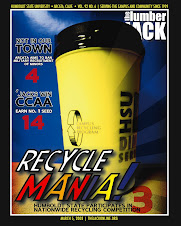
The day the new issue went up on the Web we hit an all time high of page views at 1727. The next day the site got another 1,119 which may be a second day high.
This was a nice looking issue and impressive for the first issue for a new staff. The quality of printing is terrific; the copy and graphics are crisp. The redesign is great, but try to vary the background colors of your covers. The blue makes this issue difficult to differentiate from the last issue. Also work at better contrasts for your masthead and for your heads, subheads and refers. The Lumberjack masthead was hard to read on this issue, and it was difficult to read the the page numbers on the refers in the last issue.
I sense that we have a staff of potentially strong writers; you understand the fundamentals, you don't have any problem interviewing people, and you can find good stories, but you struggle with execution. That's a good position to be in for the beginning of a new term. Here's what you need to work on:
You need to ENERGIZE your writing!
 You dulled down interesting stories. You should do the opposite: Take potentially dull stories and turn them into fascinating reads.
One problem was that you started each story with a flat lede. Zero in on conflict and contrasts. Imagine your reader is flipping through and will read only the first sentence. Here is how a number of the stories began:
- Dressed in a black tank top and holey blue jeans, Jerilyn Gashi is an average-looking student at Humboldt State University.
- Humboldt State University is marching towards becoming a veteran-friendly campus by expanding services for past and present military servicewomen and men.
- Apartment complex residents in Arcata are not reaping the benefits of the free recycling program that the Arcata Garbage Company offers.
- If you go to the Humboldt County Animal Shelter, a squat u-shaped building by the Arcata airport in McKinleyville, Calif., you might be lucky enough to see a small black and white fox terrier with a brown face by the name of Pogo.
- Local animal rights activists who oppose the treatment of circus animals hope the circus won't be coming to town next year.
- Maddy McCann, a Humboldt State University geography junior, is just one of many students concerned about their rights as renters.
Try these things:
Go for good, hard, descriptive verbs.
Instead of: Gashi is an average looking student
Perhaps: Gashi blends in at HSU.
Instead of: Apartment residents are not reaping the benefits
Perhaps: Each week, conscientious renters haul boxfuls of used bottles and cans to the recycling center while their neighboring property owners toss their recycling out on their front curb.
Instead of: Local animal rights activists who oppose the treatment of circus animals hope the circus won't be coming to town next year.
Perhaps: When the circus hit town this month not everyone cheered.
2. Trim your lede like you would a fatty piece of meat.
 You want it nice and lean. Although you want to avoid acronyms you can use one if it is instantly recognizable (such as HSU) and it can cut cumbersome syllables out of the lede. Leave out of your lead locations that the reader doesn't immediately need to know (Mckinleyville, Calif.) And leave for later, identifying information about a person that the reader can wait to find out (an HSU geography junior). You can also cut out all adverbs and undescriptive adjectives.
3. Ditch the lede altogether.
 Forget that first stab at a lede in your early drafts and look for a better one somewhere else in the story. You can usually find it hiding in the middle of the story or near the end. For example:
The lede on the men's soccer story was buried in the last paragraph. It was the upcoming game against Chico, a main rival. Always move your stories forward if possible. Readers are more interested in the games they can still go to than the ones they missed or already saw.
The lede on the veteran's services story was Jenn Fusaro who the Navy trained as a sonar technician but who came out of the Navy without the skills needed to detect life's day-to-day obstacles.
The lede on the Ozomatli story was in the eighth paragraph of the jump: Jenny Diaz who drove four hours to see her daughter in the Marching Lumberjacks and got to see this crazy band and as well as one whose name she can't even say.
The lede on the cultural immersion program was either the building of the adobe senior center (third column) or the solar-operated refrigerator (fourth column.) That's because tangible things like a building or a refrigerator will grab readers more than intangibles, such as a cultural immersion program or broad terms, such as appropriate technology. And that brings me to my next Tip of the Week:
Show don't Tell
For a story about recycling you need to show the reader a pile of bottles and cans. For a story about renters rights, you need to show readers bad housing conditions -- a leaky roof, broken windows, moldy walls.
For a story about a Republicans on campus you have to show us someone who is shocked that Gashi is a Republican. Instead you had Gashi tell us that people are shocked.
Oh, wait. That story wasn't about Republicans on campus. It was about a moment of silence. Which brings me back to the subject of the lede and my next Tip of the Week.
Begin your story with the focus of the story. That speaks to clarity. Unless you intend to deceive your reader in your lede (what I call a sucker lede, since you sucker them in to believe the story is about the opposite of what it really is) you need to let them know the subject as soon as possible, in the first half of the first sentence if possible. But the story on the moment of silence doesn't get to the moment of silence until 10 sentences down, and in the second column. Even then, the story doesn't really address the moment of silence. Instead it seems to be about the process that was required to get the moment of silence enacted. And that brings me to my next Tip of the Week:
Focus your story on what the reader will care most about.
Readers don't care that Gashi had to petition Roland Richmond. Richmond would only be relevant to this story if he denied the petition. Instead this story should be about a moment of silence that will take place. So the most fitting format would be a man on street -- asking random students, faculty and staff if they will be on campus at 9:11 am on 9/11 and what they will think about in the 60 minutes of silence. What will this moment mean for real people? And that brings me to yet another Tip of the Week:
Focus your story around Real People not "official sources":

If your readers won't really care about how Roland Richmond feels, they certainly won't care about what Paul Mann, college spokesperson, thinks. His presence in a story is only appropriate when he has information vital to the story that you simply cannot get anywhere else. Rely on public relations people for general background, for getting pointed in the right direction, for getting in touch with the people you need to get in touch with and when it is the only way to get the information. Otherwise leave them out of your stories. They make you look lazy and they make your stories seem superficial.
The renters right story suffered from a similar problem. You focused it around the Associated Students president, a tenant's rights lawyer, a City Council candidate and a workshop attendee. You needed to take the reader into an apartment and talk with a screwed tenant.
Regardless what the focus is, every story needs a focus. That was the problem with the animal shelter story. I wasn't sure whether the focus was supposed to be people who work at the shelter or recidivist dogs at the shelter. Don't leave your reader guessing. And that brings me to my final Tip of the Week:
Don't leave the reader with unanswered questions
In the story on the circus:
How many and what types of animals are in the Carson and Barnes circus?
 In the renter's rights story:
How exactly do California landlords have more rights than ever before?
In the men's soccer story:
Is Lyle Menk an up and coming star?
Did I say that was my final tip? I lied.
Don't underplay news angles.
They help draw in readers and keep their attention. In the veteran's services story you buried three potential news angles: - Despite a big budget cut, HSU is expanding veteran's services
- The Veteran's Center will move to a new home in mid-October
- There is a new club on campus for veterans
Watch your words
Use according to only for data you did not collect yourself. It implies that you don't trust the veracity of the information and why quote a source you doubt is telling you the truth?
Avoid adjectives that reflect your personal opinion: Freshman Gracie Gartrell set up the goal with an excellent down field pass...
And finally, expand your sourcing:
The Q&A was good, but an intro to a Q&A is as important as the Q&A. Turn it into a mini story of its own by reporting out -- find two people who know the interview subject well who could offer interesting perspectives on the person.
 For the circus story you needed to talk to outside circus experts: Here in Humboldt County we have a world famous clown school in Dell 'Arte and I bet they would comment on a traditional animal circus versus the Cirque de Soleil model sans animals. And at HSU we have the Humboldt Circus, a made up of a bunch of publicity hungry amateur performers.
Email me!
at mib3@humboldt.edu
Marcy's Top Ten Rules
1. Use active verbs.
2. Don't be afraid to paraphrase.
3. Question the answers to the questions you ask.
4. Substance always adds to style.
5. Honesty overrides all other journalistic rules.
6. Accuracy is not the same as truth.
7. Getting two sides to a story is not the same as balance.
8. Show don't tell.
9. Write with all five senses.
10. Give voice to the voiceless.
Movies about newspaper reporters
- Futureworld
- Salvador
- The Return of Doctor X
- Missing
- All the Presidents Men
- Scoop
- The Quiet American
- Foreign Correspondent
- Gentleman's Agreement
- Under Fire
- The Parallax View
- The Mean Season
- Defense of the Realm
- Superman 1-7
- The Front Page
- His Girl Friday
- The Year of Living Dangerously
- The Killing Fields
- Inherit the Wind
- True Crime
- The Paper
- Deadline-USA
- Call Northside 777


 h thought into your kicker as you do your lede