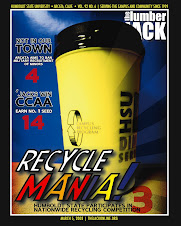
I didn't see any good ledes in this issue, but I saw several clear attempts at them, so I salute you for that. I'd rather you try and fail, th an not try. There were some good attempts, for example, at showing rather than telling.
Sourcing was better and at least one story was a disorganized mess but know that a disorganized messes is built on solid reporting.
Copy editing was sloppy again
But the mistakes weren't as frequent or as aggregious as in past issues this term. Still, you need to get nit picky about your copy. Check and double check the dictionary and AP Style: 10 not ten.
Here is a top 10 list of AP Style rules.
These are the ones you can't violate because hiring editors look for these:
1. Numbers
2. Addresses
3. Directions (compass points)
4. State names and abbreviations
5. Ages
6. Dates
7. Titles
8. Datelines
9. Time
10. Capitalizations
Ledes
You buried the ledes on two of the stories in this issue. In the protest story I found the lede in the middle of the jump: When Veterans for Peace first started an anti-war vigil on a Eureka corner, residents gave them the finger. Now they honk in support.
In the Internet cafe story I found the lede in the third paragraph up from the bottom: When the curtain now covering half the library lobby lifts, you'll be able to get coffee and pastry with the books you check out. But if you are looking for the workout room you are out of luck.
You buried the cover story. It was Frank Cheek's 1000th victory. Remember that tightening and reorganization can work wonders.

Fall in love with the period.
It is our most underappreciated punctuation mark.
On the cannibis story here's how a lowly period could make a difference.
Your lede:
This is how a revolution starts, said Daniel Pasko under the cover of Arcata's giant redwooods.
Here's what the period and a little reorganization can do:
Daniel Pasko, his brother and a friend, stand under the cover of Arcata's giant redwoods. They talk about cannabis. This, Pasko said, is how a revolution starts.

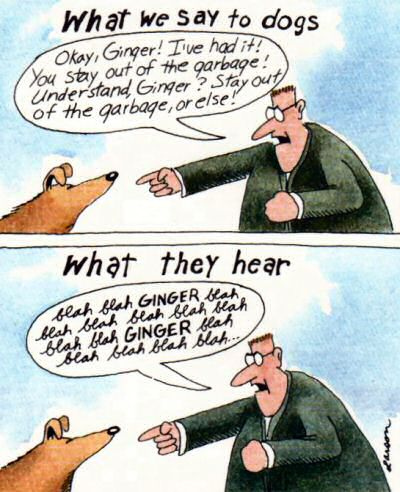
Cut out the blah, blahs.
That means deleting the three paragraphs that you took from Bunch's email. Ask yourself, what did he say that's important. Paraphrase it for the reader in one or two sentences.
The Internet cafe story was the disorganized mess. This story needed an outline. You should outline every story you do, even the sports stories and the editorial. But you must outline any story that has multiple elements.
I. Lede
II. Quote
III. Nut Graph
IV. Point A
V. Point B
VI. Point C
VII. Kicker
Clean up your messes
Meanwhile the story about the Cabinet for Institutional Change was just a mess. It left the reader with more questions than answers. The very wording was confusing. What did you mean by "Coming in September of last year,..." Either it is coming this September or came last September. The reader doesn't know whether to look ahead or back.
Question the answers the questions you ask
You let Snyder say that he selected members of the council by vetting the nominations through various constituencies around campus. But who were they and why did they have such power. And which nominees got nixed in this way and why? And who did the nominating in the first place?
Design was crowded and remains uncreative.
You have many talented photographers this term. You are underutilizing them. When your writers struggle to show don't tell, photographs can help fill in that gap. They tell by showing.
In sports, you needed to go deep.
That means that when when Enos told you that she wore her dad's num ber on her jersey, you needed to track down the father for an interview. When she told you that she is who she is because of her brother, you needed to track him down, especially when we find out that he is in or just came back from Iraq. Listen to what people tell you and follow up.
That's how to make good stories great.
Write for the reader who doesn't have a clue.
Your story on Figgatt suffered because you wrote for the reader who follows the basketball team.
You lead the story this way:
Senior baskteball player Jameson Figgat, known for his trademark face-mask...
But the reader who has spent the term in the library instead of the gym d oesn't know what you are talking about and feels stupid. Never make your reader feel ignorant. Instead you want to make him feel empowered by giving him information he didn't have.
You won't lose the reader who knows by including background. The reader who already knows will simply skim that information quickly until she gets to the part she doesn't know.
 You came up with a nice cover and matched it with a nice center spread. In this issue I saw some good stories but many that had inappropriate and insufficient sourcing and which reflect lazy reporting.
And you reported on line how the Lady Jacks won 20 games for the FIRST TIME IN HISTORY but there was no mention of that in the paper. In that story online, you mostly quoted the coach when you needed to talk to the women on the team.
First the good
You painted nice pieces about the Humboldt Crew team and the people on the track and field team.
Both had terrific ledes:
 Not even a stomach ulcer can stop Varsity Rower Hannah Mills from waking up at 5:30 a.m. to do what she loves.
and Sophomore Jasmine Seymour was the last woman standing in the high-jump competition. With two tries down and only one attempt let, she faced the horizontal bar measuring five feet and eight inches.
"I can't do it."
There were some nice online-only pieces as well.
Nice showing for the men's basketball story, although you buried the lede. What a difference 24 hours makes is cliche and always avoid cliche. Instead you should have lead with the free throws which Cheek says he will never forget. When reporting an action-packed game, slow down. Select just the best plays and show them to your reader in slow motion.
Now the Bad
Other stories were convoluted and superficial. They suffered from poor sourcing. Your story is only as solid and thorough as your reporting. The parking story was a rehash of previous stories and gave the reader no new insight into a long-standing problem.
You buried the lede for it, as well:
It took Rhiana Jones 20 minutes to find a parking spot the other day. She left one lot, tried another and then had to return to the first before one opened up "It doesn't make sense that they sell more permits than available spots," she said.
In the story on emergency preparedness you failed to talk to any students on the CERT or any students concerned about the possibility of an earthquake or other emergency.
The lede on the KHSU story was long and tedious as was the rest of the story. You allowed Patrick Cleary to say little and even to keep secret the salary he will pay som eone to run a non-profit, public university-owned radio station. When people give you blah blahs and gobbly-gook, force them to give you specifics that are meaningful to your readers.
Ask good questions:
What do you mean exactly?
How much exactly?
When exactly?
The story on broadband also suffered from poor sourcing. You needed to talk to stu dents frustrated by slow connections. You also failed to give readers important information.
You mention that the governor cut red tape allowing the project to take off but you don't tell us what red tape and what you mean by the project taking off and when and how it will do so. When exactly will it start? When exactly will the cable
Don't confuse the news angle with the news
The Q&A with Lori Dengler focused on the award she won, when the reader doesn't care about awards. And you quoted a woman who never took her class rather than people who new her well. The trick to a good Q&A is that you need to report and write the introduction as you would a stand alone story -- it needs to explain to the reader why it is important they hear what the person says.
In the Q&A itself, Dengler says some interesting things but you fail to follow up. Instead after she says she has been to obscure places and that she was a reluctant scientist you follow with a question about the award. Instead you should have asked her what obscure places be laid or the satellite dish installed and when exactly will residents get the new hookups? And why are you quoting the CIA factbook for this story?
and what they were like, and what did she mean by a reluctant scientist. That's how you get the anecdotes that bring a person to life.

 You give us a short piece about Discovery Walks in Eureka, but you failed to take your readers on the walk.
And here again was a great opportunity for a map.
Finally, as in the intro to the Dengler Q&A, you quoted someone who hasn't been on one of the walking tours rather than someone who has.
 You designed a nice cover, and you did so at the last minute. It provided readers with multiple entry points. It attracts different types of readers. This was the second 24-page issue in a row. Since times are rough, you need to prepare for less space. So rethink how you use page 2. Your Mission Statement and contact information takes up a quarter of the page and your table of contents takes up half a page. You might want to use some of that valuable space for art or an article.
What your classmates liked:
- Nice crisp action photos
- The cover
- That the fact box on the Purim story was a Jewish Star
- That some pages had more than one story
- Use of pull quotes
- The story on Family Pact
- The center spread story on the speaker booed
What they did not like about this issue: - The table of contents promised a photo essay but the issue didn't deliver it.
- Lousy photo for the climate change story
- Lack of photos of protesters for the center spread story
- Odd fact boxes on the sports stories.
- The lead on the budget story.
- Wrong sourcing on one story.
- Not enough info boxes
- Cover
You still need to work on your ledes. Many were wordy, boring and did little to inform the reader: For the sixth year in a row, the California State University system is receiving more cuts to its budget.
Uncertainty is widespread regarding an off-campus budget retreat held Feb. 20 and whether or not open-meeting laws were violated.
Global climate may soon collapse due to Amazon deforestation.
California could lose federal funding for the Family Planning Access Care and Treatment (PACT) program unless it begins verifying the immigration status of its participants.
The International Cultural Festival offers HSU students a taste of 18 different countries and cultures.
So when writing your lead, ask yourself: What is this story about? And if the lede you wrote doesn't answer that question, look for the lede elsewhere in the story. It is probably hiding smack in the center of the story, at the very end or three paragraphs up from the end.
When your story deals with a big macro subject, like global warming, zero in on something the reader can understand for your lede. In the global warming story your lede might be that biofuel crops lead to deforestation. So even as people try to be more ecologically correct by going off petroleum, they end up decimating forests.
Avoid citing Paul Mann as a source
Make your passive sentences active.
Not: For the sixth year in a row, the California State University system is receiving more cuts to its budget
Instead: The state will cut the CSU budget for the sixth year in a row.
Not: The meeting was canceled without notice to the public.
Instead: The budget committee canceled the meeting and failed to give notice .
.
To make a passive sentence active, trying flipping it.That will force you to identify the true noun and verb.
Info box tedious details.
In the budget story you tell your readers that fees will increase, that they skyrocketed since 200 and that there are 450,000 students in the system. You give us a bit of a timeline and assorted financial figures. Box all that data out. And graph the information as well.
Don't use the word "claimed."
It suggests you doubt the information, and why give your reader information you doubt?
Avoid citing Paul Mann as a source.
It makes your readers think you are lazy. If you try hard to speak to any other administrators and the road always leads to Paul Mann, let your readers know that.
Go for  universals
In the story about Purim, understand that Purim is based on a biblical story about a Jewish woman, named Esther, who risked her life to save her oppressed people. So even if you aren't Jewish, you can identify as a woman. And even if you aren't a woman, you can identify if you are a member of an oppressed population. These are universal themes.
Don't forget the Nut!
When you have a story with multiple elements you need to summarize in a nut graph, all the elements that will be in the story. It is usually the second or third paragraph of the story and tells the reader why it will pay to read to the end. A good nut helps you organize a complicated story.
Tell your readers how they can take action
You could provide a box of names and email addresses for local legislators with the Family Pact story so that people could tell their lawmakers what they think.
Show don't tell
The cultural festival story needed all five senses -- sight, sound, smells. You needed to talk to someone who went last year and have the person describe the most interesting food he ate or the neatest thing he saw. Remember to focus on the micro not the macro. So instead of telling us about all the different cultures at the festival zero in on one or just a few of the most interesting.
Flip your story
In some cases, you wrote the entire story backwards. That's what you did with the Mayhem ensures piece. It isn't until the second page that you get to the mayhem.
You needed to flip the Jagun Fly story as well. The most interesting part of the story is that the author is a former HSU student who is now a successful playwright. That needed to be in the front of the story rather than the back.
Let's see some consistency on photos.
While I spotted great action shots in Sports, the photos for the international festival were terrible. And you missed a great opportunity for a graphic. Within the Jewish star for the Purim story you informed readers that the event would be at the Beth El temple. But you didn't tell them where that was. You could have created a quick Google map and put it inside the Jewish star.
Say what you mean
 You start the editorial off with the word shit, which offends even my sensibilities and I am quite partial to the use of expletives when there is a reason to use them.
The gist of the editorial was in this paragraph: "Now, more than ever, we depend on each other to get out of this sink hole. If we are going to pull ourselves up out of this we have to change and adjust our perspectives."
The editorial seeks to unite but its first words are divisive. Remember, you speak for all students, those who might curse and those who would never. Speak a language they all can understand.
Don't bury your ledes
The lede for the story on Gracie Perez was in the third paragraph: Gracie Perez never cared about records. Good thing, because she breaks every one she comes up against.
The lede in the budget story was in the second column. To Beth Wilson, the thing that differentiates HSU is small class size and how professors know the names of their students. Budget cuts might make those things disappear.
Email me!
at mib3@humboldt.edu
Marcy's Top Ten Rules
1. Use active verbs.
2. Don't be afraid to paraphrase.
3. Question the answers to the questions you ask.
4. Substance always adds to style.
5. Honesty overrides all other journalistic rules.
6. Accuracy is not the same as truth.
7. Getting two sides to a story is not the same as balance.
8. Show don't tell.
9. Write with all five senses.
10. Give voice to the voiceless.
Movies about newspaper reporters
- Futureworld
- Salvador
- The Return of Doctor X
- Missing
- All the Presidents Men
- Scoop
- The Quiet American
- Foreign Correspondent
- Gentleman's Agreement
- Under Fire
- The Parallax View
- The Mean Season
- Defense of the Realm
- Superman 1-7
- The Front Page
- His Girl Friday
- The Year of Living Dangerously
- The Killing Fields
- Inherit the Wind
- True Crime
- The Paper
- Deadline-USA
- Call Northside 777

 an not try. There were some good attempts, for example, at showing rather than telling.
 hiring editors look for these:
 ber on her jersey, you needed to track down the father for an interview. When she told you that she is who she is because of her brother, you needed to track him down, especially when we find out that he is in or just came back from Iraq. Listen to what people tell you and follow up.
 oesn't know what you are talking about and feels stupid. Never make your reader feel ignorant. Instead you want to make him feel empowered by giving him information he didn't have.