First some news about the Web site. On March 12, the day the budget deficit issue hit the stands, page views for thejackonline.org hit 1,077, breaking the one day 1,000 mark for the first time and the following day the site got another 981 page views.
That week we broke 4,000 page views for the first time. On March 25, the day the CSU Cash Crash issue came out, we also topped 1,000 page views and we will likely top 4,000 page views again. How significant is this? It took us eight school months after relaunching the Web site in Jan. 07 to reach 3,000 page views: The Oct. 22 football issue. Five issues in '08 exceeded that weekly mark.Students in class had both good and bad things to say...
Some noted that they liked the lead story, the lede on the lead story, the photo spread, the cover, and the story about online classes.
They said t hat most of the other ledes were dull, the issue needed better headlines, the two sections of the photo spread needed clearer separation, the stories lacked info boxes or other graphic elements to break up gray copy, and in general, the layout was boxy.
The cover looked great as did the rest of the issue. Terrific lead story. The other stories suffered from some technical writing problems, but considering you produced this issue right after spring break, this was a great effort.
On the whole the stories in this issue are readable but many needed one more draft because there are annoying problems that you should catch on a third draft.
1. What do you have against short?
Long ledes and sentences asphyxiate the reader. Long paragraphs send them to other stories that are easier to read. And if the sentences are long they are probably passive? Why? Because on second read you will find that you can cut in two or three long sentences written in active verbs.
Imagine yourself in a cold and quiet museum. You can't touch anything. You don't interaction with the artists or even other observers.
 The story about the campus rally had a 34-word lede.
- The online courses story had a 35-word lede.
- The Arts Arcata story had a lede that was too long to count. This one was active. See how easy it is to break up:
Now imagine that that live musicians, artists, excited spectators surround you. You feel their energy. People offer you wine to sip and cheese to eat as you gaze at a bright, lively work of art. The artist greets you. That's Arts Arcata.
- The baseball club story had a 38-word lede. But it's easy to shorten on one more draft: Baseball at HSU may be just a club sport. But don't use the word "just" to Zachery Youngs. "We need to prove that we are good enough for the NCAA," said the second baseman and marine biology freshman.
 Save those long ledes and paragraphs for the future stories you will write for New Yorker magazine.
2. Use active verbs.
The good news is that I find fewer cases of passive phrasing with each issue. But don't slip. Strong verbs separate great from mediocre writing.
Not: Humboldt State is missing opportunities to gain more African American faculty...
Instead: Humboldt State misses opportunities to recruit...
Not: The CSU budget is being cut by...
Instead: The state plans to cut $386 million from...
Not: Humboldt State has more interest now than ever in developing online classes.
Instead: Now more than ever, online classes could alleviate a number of problems Humboldt State faces: Budget cuts, overcrowded classes, and swollen enrollment. And though interactive technology makes online classes possible, the school only offers eight this semester.
Tip: To make a passive sentence active try flipping it. In passive sentences the noun is tucked somewhere at the end. It needs to be in front of the verb. And there should be nothing separating the noun from the verb. In the sentence Humboldt State has more interest, for example the noun is Humboldt State, but the verb is to interest but the words has and more separate the two. Or the verb is to develop. If you flip that sentence the noun becomes online classes and the verb becomes could alleviate.
3. Avoid acronyms not widely recognized.
The Tuition Relief Now story flowed well until I got to the jump on page 5 where the identification of Lladira Baez as a CSSA representative stopped me. I had to go back to page three to try to find the first reference. It wasn't there, but even if it were, you don't want the reader to have to go backwards in a story, ever. Instead of the acronym, on second reference give a shortened version of the full name that helps identify the organization. If the organization was the Sierra Club Legal Defense Fund on second reference you say the legal defense fund rather than SCLDF. If the organization is the Humboldt County Committee to Save Wild Ferrets, on second reference you use the wild ferret group rather than HCCSWF.
4. Don't balance your story as an afterthought.
In the Tuition Relief Now story, it is not until paragraph 17 that the reader finds out that some people oppose the proposal. That needs to be in the nut graph and it needs to be an important part of the story, rather than a toss in.
And remember that for every story, there are many sides to an issue. You want to try to get as many as possible, but never frame a story as if there is only a for and an against. Some people, like Rollin Richmond are sort of for and sort of against. Some aren't really against, but they see better options out there. Give your readers the opportunity to consider different possibilities and make up their own mind.
5. Don't repeat.
In the Campus Unites story you told readers about the statewide budget cut (implying that they should already know about it). Then in the second paragraph you tell them about the $386 million budget cut. Then in the third paragraph you tell them that Schwarzenegger proposed a $386 million budget cut.
6. Don't assume the reader knows ANYTHING
In the Campus Unites story, some of your readers don't know anything about any budget cut and to tell them about the cut without informing them that there will be a cut risks this response: What cut?
Then in the fourth paragraph you talk about the alliance without telling them about any alliance. So the natural response is: What alliance?
The problem with this story is that you failed to ask: What is this story about? Its not about the cuts, because you reported the cuts in previous stories. It is not about the rally, because readers don't care about a rally they already attended or can no longer attend. So what is it about?
- The banding together to fight back. So that needs to be in the lede.
- A bunch of people who, as Richmond said in paragraph No.10, who are all frightened.
- It is a story about the fighting back, so you need to tell your readers early on how to do that. You don't want to wait until paragraph No. 11 to tell them that they need to contact their state officials.
So here's the story: Nervous that the school will cut the class you need next year to graduate? Don't want to sit on the floor? Worried that the school will layoff your favorite professor? Angry that the fees you pay keep rising each year? Write your legislator. That's the message that a packed room of people took to heart on Monday at a rally about proposed cuts to the California State University budget.
7. Avoid all adverbs and any adjective that doesn't show.
- In a completely packed Kate Buchanan room...
- ...were a few questions this great thinker addresed...
- Whimsical artwork fills the walls...
- ...elegant and unique centerpieces...
- ...they completed the year with a solid 20-9 record...
- ...and gained valuable playoff experience for the younger players...
- ...but it is also a great bonding experience.
8. Find passionate people for your stories.
The story about online courses needed a student for whom the online course makes the difference between enrolling or not.
9. Don't forget important details.
The story about men's basketball ending in Alaska failed to tell me when the defeat occurred.
10. Zero in on conflict
The Easter story wasn't a story about "diverse" Arcatans, it was a story about Jesus versus the bunny and how people reconcile these two very different icons. So the lede is this:
For Eureka resident Adam Dick, Easter is a time to celebrate in church the day Jesus rise from the dead. For Blue Lake biologist Becky Dutra it's a potluck and beer hunt.
But this issue looked nice. Besides the cover, the photo spread on the inside was terrific and nice jobs on the basketball layout on age 9 and the bunny layout on page 19. And finally Forum looks good!

In the class critique some students said they liked:- The editorial
- The cover
- The perilous plunge photo essay
- The hard hitting stories
- The improved layout of the forum section
Some students said they didn't like:
- That the cover exaggerated the budget problem
- That you praised the 'Jacks in the editorial but gave them short shrift in the sports section
- That too many stories lacked art.
This was clearly the best issue of the term.
It had hard-hitting stories, clean copy and it looked great. But you still show problems with: - Buried ledes
- Transitions between speakers
- Stories that read like press releases
- Boring headlines
- Story organization
- Making your stories compelling
- Grounding your reader
Let's take a close look at the cover story
This was a well-reported story, chock full of good information. But it suffered from two problems:Poor organization and passive phrasing.

Remember the Burstiner Mantra:
What's the story?
Is the story about a budget? No, because the reader doesn't care about a budget. Instead the story is all the things the students, staff and faculty willlose because the state will shortchange the school once again. So the lede isn't the school faces uncertainty or that it learned some bad news. The lede is located in at the bottom of the third column, smack in the middle of the story:

Try moving your paragaphs around on second draft:
Next fall, expect HSU to eliminate some courses you might need, layoff professors you might like, and end services you might depend on. Expect even more crowded classes and higher student fees. That's because while the school expected to get almost $5 million more next year than it did this year, it now expects to get less. A lot less.
But if you are here, you're already enrolled. If you've got a brother, sister or cousin planning on coming in the fall, consider this: The budget cuts will force CalState to close the doors to some 10,000 students it could otherwise let in.
Each of the 23 CalState campuses is in this same financial boat. They've already swallowed a total of more than $500 million over the past eight years; that's almost $22 million per campus.
And despite the cuts, Humboldt State must still pay for increased costs of such things as utilities and salaries.
That means that the cuts must come elsewhere.
Passive phrasing dulled this issue:- Humboldt State was notified...
- Humboldt State is facing...
- The proposal was for a cut...
- Humboldt State was expecting to receive...
Careful how you include numbers in a story.

Too many digits break up copy flow and send readers to less tedious stories. It doesn't matter to most readers whether the story is about $4.7 million or $4,747,000. But the first number requires them to read five words (four point seven million dollars) while the more precise number takes nine words: Four million, seven hundred and forty seven thousand dollars. For more on how to use numbers in your articles, see this story.
Don't bury your ledes.
- The flu hits Humboldt: The lede was Kelly Ridgeway who came to school to take a history exam even though she was sick only to find people hacking all around her and who had the professor cancel two classes the next week because she was sick.
Meanwhile the kicker for that story was Stephanie Burkahlter who called it Deathbed 2008. - Horses: The lede was how in 2003 Sara Isaacson bought a quarterhorse who had gashes across his chest from being whipped.
- North Coast Parents: The group offers members a week of free meals to members when they give birth. That's pretty nifty and might call for a YOU lede: If you are in your fifth month of pregnancy consider joining Northcoast Parents. When the doctor delivers your child, they'll deliver a week a free meals. That that's just the beginning of the support the group offers.
To begin the story that way, changes the whole story. It forces you to listen to something said as an aside and zero in on what it means. Because you then ha ve to ask: How does that work? A week worth of meals is 21 meals, does that mean that 21 different people each take a meal and drive it to Lolita if that's where the new parent lives? Does each member take a three meal day? Do they just call 21 different food delivery places and pay for delivery? A week of free meals takes five words to mention, but the coordination and volunteer time behind those five words takes a whole story to explain. And it gives you the opportunity to talk to the people who received these meals in the past and the committed volunteers who help organize and carry it out.
Some stories ended with nice kickers
 But try breaking up your quotes for better effect:
 "I'm glad they're having an event like this, I can't wait to go and stuff myself," Moreno said.
Instead:
"I'm glad they're having an event like this," Moreno said. "I can't wait to go and stuff myself."
The same with this nice kicker: But she also helps for the simple reason of loving them. "Just being next to one of these animals, cleaning its poop or whatever, settles my heart and mind," Zarnes said.
Instead: "Just being next to one of these animals, cleaning its poop or whatever," Zarnes said, "settles my heart and mind.
 Don't catch yourself churning out press releases.
When you must use a press release to generate an idea for a story, view the release the same way you would an event you must cover. The event isn't the story; neither is what is on the release, at least not unless the release is about a vitally important piece of news.
The story is something else that touches people. So take a press release and look for the real story behind it. So a story about Patty Berg winning an award is not a story about Patty Berg or the award. It is the reason she won it, which is a bill that allows dying people to take control of where and how they die. How difficult was it for Berg to get that passed? What opposition did she face? How did she overcome it? What will she do now to further this type of legislative agenda? That's the story.
That means that either the headlines, the lead or the body of the story didn't give the story the life it deserved.
Take the story about the mediation group.
It is a story about a group of people who joined a non-profit (translation: they aren't in it for the money) to jump into arguments most people avoid. But the arguments they mediate are not the story here so your problem is that you have a story without conflict. Instead what makes it interesting is the contrast between what is normal or expected and what you present. This is known as the
Man bites dog story
 The reader expects a dog to bite a man. But for a man to bite a dog is the opposite of what you'd expect.
Anytime you suspect you have a boring story to report look for unexpected contrasts: A rich person helping out poor people, a timid person who's a monster on the football field.
For a good example, look at the story on Sunshine week, which the reader might expect to be a glowing story about how much Congressman Mike Thompson is doing to promote transparency in government. Instead it begins with how hard it is for regular citizens to talk to a congressman, and the contrast between the ability of Thompson versus the normal person to access government info.
Ground your reader
The story about Jason Robo was confusing even if you knew a little abou t Jason Robo. Without knowing anything it seems as if the AS kicked off a guy for missing two meetings. That doesn't make sense. It mentions that he aired dirty laundry but it doesn't explain. You can't talk about dirty laundry without showing the dirt. Also you mentioned that he is active with NORML but you don't explain what that is and the little old lady in Fortuna has no idea. Meanwhile you left out that he is as active with 911Truth and that gets him labeled as an anti-government conspiracy theorist.
Paraphrase lousy quotes:
"The best time to apply is the beginning of your senior year."
Why should that be in quotes? Use quotes when someone says something better than you can say it (and remember, you are the writer with the power of words).
"Baloney!," she said the week before the fatal accident. "It'll happen over my dead body."
Finally...
Nice job on editing.
This was the cleanest issue in terms of typos and grammars all year.
 At the critique session in class...
Students said they liked:- The fact boxes
- The story about lunch trucks
- The bold color on the cover
- The sports section
- The story about the ban on military recruitment
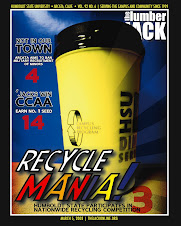
Some students said they didn't like:- The choice of the recycling story over the story about the 'Jacks CCMA championship win.
- The layout of the Forum section is still too gray.
- The story on the reopening of the Women' Resource Center overlooked how hard the people who are behind it had to work to get it reopened and how the university fails to support it or other worthy organizations on campus.
- That the editorial didn't go far enough.
I want to address the cover, the editorial and the Forum section in more depth.
1. What goes on the cover?
From the reader's perspective this is an easy question to answer: The most important story in the issue.
From a practical standpoint however, there are a number of factors that determine the cover:
- The cover must be designed in advance. That means that the story needs to be in or the editors need to be darn sure it will come in early enough to get in the paper. What does that mean? That the newer the reporter covering the story, the less likely something will happen, the less determined the outcome of an event, or the less reliable the reporter covering the story, then the less likely the story will make the cover if the editors don't have it in hand early.
- Available art: Why do dog stories and stories about children make it onto newspaper front pages? Partly great art possibilities. A story that is difficult to illustrate or that is difficult to photograph will be less likely to make it onto a cover.
But let's say a story meets those two criteria. Then a paper should put its most important, most contentious story with the most reader interest on the cover.
Let's forget art possibilities for a second. What stories in this issue were cover-worthy? Arguably the championship season for the 'Jacks regardless of what could happen after deadline Tuesday. But the elephant in the issue was the editorial addressing a campuswide email from the university president about a reported incident of racism off-campus.
That brings up the second passionate argument made at the the beginning of the Lumberjack class.
2. Did the editorial go far enough?
I think that question misses the real issue, which is that the Lumberjack addressed the email in an editorial without reporting the story in the first place. The president sent out the email Friday, which left all weekend to report the story, get facts from the Arcata and/or university police, and get man-on-street reactions from students, faculty and members of the community. The Lumberjack should have leapt on this issue, particularly since the campus was scheduled to hold a summit on social justice the next week and that's the Diversity Conference under another name. Failure to do this reflects a number of possibilities: Laziness, inexperience, insensitivity, incompetence or a problem in measuring and understanding news value.
Meanwhile the editorial wasn't the only problem with the Forum pages. I couldn't understand why you said you didn't have enough space to run all the submissions that came in but you had space for yet another Tom Jones rant and another rant by Jason Robo, two people who you have given more than enough space to in past issues. You need to prioritize your space:
- Is the person a new/fresh voice? You want to give voice to the voiceless, not a soapbox to someone who already has one.
- Is the person someone your readers need to hear from? If President Richmond sends the LJ a letter you probably want to run it.
- Is the issue the person addresses an issue the Lumberjack hasn't addressed or that readers need addressed?
I think you need to come up with a policy and put it down in writing to limit guest submissions to three columns per term. The entire student body subsidizes the printing of the Lumberjack, so you want to encourage as as many people the opportunity to express themselves in it.
Note too, that it is the Forum editor's responsibility to work with column writers and those who submit letters and help them improve the clarity of their submissions. The editor should fact-check columns and, with the writer's consent, fix grammatical errors and make sure than the writer understands when something in the column could be taken as offensive. If there are factual errors that the editor finds but that the writer refuses to correct, the editor should include an editor's note. See this column by the editor of the New York Times Op-Ed pages on how that paper handles guest op-ed columns and letters to the editor.
What else?
Good stories in this issue included the one about military recruitment, the story about the lunch trucks, although it begged for a map -- still great page design. I loved the men's basketball story. Terrific story on Devin Peal. The writer even managed to track down Peal's former summer league basketball coach. But the headline was a yawner. So...
You need to get more creative with headlines.
While there were several good ones:
- Let's get ready to recycle
- Not in Our Town
- Arcata says "See Ya" to recruiters
The rest were either dull:
- Women's Resource Center celebrates grand reopening
- Art of the centuries: exhibit looks at mythical meanings and social interpretations
- Basketball says goodbye to skillful leader
- Last home game for two women's basketball players
- Academic Senate submits concerns to Richmond
Or they didn't tell me what the story was about:- Settin' the record straight
Don't promise your reader what you can't deliver The story on recycling promises SEXY and MANIC and the story doesn't deliver on the promise. It was a good try at making a story about garbage interesting. Remember...
Ask: What is my story about?
On one level its about recycling and not using, on another level it is about a competition. And competition means conflict. So here you have a story about conflict over garbage. And you have Stanford University and competition over garbage. It's hard for a school like Humboldt to beat Stanford University at anything. But this month students here will try. There's a nationwide contest for waste minimization this month and those anal Stanford students seem to produce less trash than any other school in the country.
But some HSU students believe that with a little determination some ugly looks at people carrying coffee in paper cups, HSU can leave Stanford in the garbage heap.
And remember that your story is about PEOPLE not objects.
This isn't a story about garbage it is a story about PEOPLE who will try to avoid throwing things out.
Passive phrasing also dulled this story:...bringing sexy back to reducing
...will continue to compete... ...bringing plastics, compost bins... ...will continue to compete in... The Campus Recycling Program is the driving force behind... The competition is divided into... Plastics can travel...
...paper is the biggest product that people are throwing away...
Use Active Verbs!
...make recycling sexy
...will compete to...
In the lede, the WHAT is more important than the WHEN or WHO, unless the WHO is Arnold and the WHEN is tomorrow. While the military recruiter story was interesting and informative, the lede starts with the past and a group of unnamed people. In early February, a group of local parents, teachers, students and counter-recruting activists drew up plans for an ordinance that would...
That's 22 words that don't yet tell readers what the story is about and that don't hook them in.
Ask yourself:
- What is this story about? It is about a law? No.
- Who is this story about? Is it about a bunch of people trying to pass a law? No.
It is about whether military recruiters will be able to prey on youth in Arcata. So that is your lede.
You had the same problem with the Art of the Centuries story. First you needed to show more. Also what is the story about?- Is it about a man who is putting on an exhibit?
- Is it about an HSU alum?
No. It is about a crazy artist who spent six years trying to find utterly ordinary stuff and considers all of it art for very interesting reasons. So I'd lede with the stick, which according to the photo, looks like a perfect ordinary stick you could find on any beach. But Soderstrom had to travel the world for it, and to him it represents all kinds of things. Art stories tend to be inherently interesting because most artists are inherently crazy so you want to bring out that crazy genius in the artist in the story. Zero in on genius and wierdness and insanity, don't ignore it.
You had the same problem with the story about the new Rofes Resource Center. What's this story about? A new center? Eric Rofes? Or an attempt to keep Rofes' work alive. Here's your lede:
Until his death in June 2006, Eric Rofes was a firm believer in coalition building. Now there's a building on campus dedicated to keeping his dreams alive.
Think about your sourcing
Don't use sources in your stories who don't belong in your stories. And don't let sources bully you into doing stories or bully themselves into your stories. Before spending significant amounts of time and energy with sources vet them. Is the source: - Someone most affected by the problem?
- Actually responsible for the problem?
- Someone with actual expertise to explain the problem?
- Someone with power to correct the problem?
And when someone suggests a story ask yourself: - Is this problem new?
- Is this problem important?
- Has the LJ or some other publication already covered the problem?
- Can I add something new that the reader needs or wants?
Those were my thoughts going into the Academic Senate story until I got to President Richmond. Then I said, "Oh!, Richmond granted the Lumberjack an interview. That is new and different." But I didn't get that until after a 46 word lede about a Bill of Particulars that the Lumberjack has already written about twice.
What's this story about? Richmond has until May 11 to answer the faculty's complaints but he decided to sit down with the Lumberjack first. But after devoting one very long graph to him, you spend eight more graphs with Lou Ann Wieand before getting back to Richmond. You devoted two previous very long articles to the faculty complaints, you needed to focus this story around Richmond's response, particularly since it was an exclusive interview with the Lumberjack. But good job on getting that interview.
The Delete key is your friend.
Use it often. Several stories in this issue were too long for their content. KILL unnecessary graphs. On second draft ask yourself for each graph: - Does it add new information to the story?
- Does it show anything different?
- If I delete it will it make any difference to the story?
Try deleting and repasting graphs with the cut and paste shortcut (Control X/V on a PC, Apple X/V on a Mac) and see what difference it makes to the story.t's like jumping into a pool. While you will find you need some nerve to do it, once you do it makes you feel better.
Love the photos.
While you needed people in the recycling story (it is a story about a competition not garbage), the sports photos were killer and I liked the photo of the art stick.
Finally:
I love the redesign of the Contents page. And I love how some of you are responding to my critique by commenting on this blog.
 Design
There was nice consistency of design throughout this issue. The cover looked good and you did a great job on the redesign of the Contents page: It is nice to see you taking the care and time for the pages that many people overlook. I liked that you tried to be creative with the graphics for the autism story, but a needle pointed at a brain made me think of a lobotomy. and I don't think that's what you aimed for. Nice use of color and layout of the sports spread. But pages 8 an 9 were too gray and the forum pages are still too gray.
I'd like to see you being even more creative with the layout of the text -- imagine the text of the Brook Adams story in the shape of a ukulele or against a ukulele backscreen. Also, when writing about music find the relevant Website for your readers so they can sample the music. You could have provided a number of ukulele related sites people could go to. A little research goes along way.
Just as a story about music needs to link to music, the story about a mural needed art of the mural. Don't wait till the last minute to contact your photo editor. If your story has a visual element to it, get a photo of it. The story about Brothers United also needed art.
Writing
Great story on the HSU Children's Center. While the headline was dull, it looked nice. Nice photo. Good information, nice organization, good sourcing.
But the story on Rollin Richmond took too long to get into and was convoluted.
It begins with this lede:
Last, week the ad hoc committee created a Bill of Particulars, a list of faculty grievances, from the October 18-22 Academic Senate Poll;...
But the reader doesn't know what the ad hoc committee is or what poll you refer to. Th en in the fifth paragraph you say that a major concern is the president's treatment of David Wells and at the time Step was donating more than $7,000 to track and field. Again the reader doesn't know anything about David Wells or why Stepp was donating money or what the heck that has to do with the ad hoc committee or a Bill of Particulars or Rollin Richmond. In this sixth and seventh graphs you say that Stepp decided to go on record and was harassed. But you don't tell the reader how he went on record. Meanwhile, all of that doesn't seem in any way to connect to the Bill of Particulars.
Also convoluted was the story about John Waters and his autism. Was this a story about autism, about a man who overcame autism, or about a man who is trying to publish a book? The reader isn't sure. The problem was that you spent to much time on the details of his attempt to publish a book and that's something that the reader doesn't likely care about. You needed to focus on John Waters as a person and his battle with autism.
Clarity is as important as honesty and accuracy. Don't confuse the reader.
You need to:
1. Focus
2. Slow Down
3. Ground your reader
Ask yourself: What is this story about. Once you answer that stick to it. If you find tangents, put them in a sidebar or leave them for next week.
The Poynter Institute has a great tip sheet on checking for clarity in your second draft.
I think part of the problem with the story on Richmond was that you relied on people like To m Jones and Dan Faulk who have their own strong agendas.
Don't let sources bully you with the force of their personality. Because what will happen is that your coverage will skew towards and in favor of the people who are loud and insistent and you will underrepresent those who are quiet. You don't want to give voice to those who already have a voice, you want to give voice to the voiceless.
There were some nice ledes:
There are games to look forward to and then there are games to look forward to.
People think that individuals with autism are insulated from the rest of the world; often that isn't so. This is not only what John Waters believes, this is what he knows.
Also the story on Option B had a great lede, which is too long to repeat here.
Careful with spelling
I caught two misspelled words in the intramural story. That was from the story on intramural sports which had at least two misspellings.
Careful with wording
You focus on, not focus from Intramural sports. Also, people don't really rejoice when they cut off their dogs balls. A rowing team is an it not a they.
Careful with sentence structure
The editorial continues to be awkward. Consider this sentence
History and different environments are what the city council feels make Arcata unique.
That's terrible! First of all, a city council doesn't feel. City councilmembers feel. Second you needed to flip this passive sentence. What's the noun and verb? Instead:
Members of the Arcata City Council believe that the town's history and different environments make it unique.
Fall in love with punctuation.
The colon can be a powerful ally but don't misuse it: You need to capitalize the independent clause that follows it. You made this mistake in the lede to the intramural story and in the editorial. Read Strunk & White's Elements of Style. Or read the online version for free.

Tighten your writing. Toss unnecessary words. The editorial is too long. Readers appreciate short. Think short. Next time you write an editorial kill 200 words without losing any substance.
Kill the widows and orphans
That's the term for any hanging word or words at the end of a paragraph. You want to cut enough words out of your paragraph so that the hanging line disappears. But you want to do that without changing the substance of the paragraph. After you do that to every paragraph, change your margins in Microsoft Word. That will give you more widows and you repeat the exercise. If you do that three times or more, you will find your writing is nice and tight.
Email me!
at mib3@humboldt.edu
Marcy's Top Ten Rules
1. Use active verbs.
2. Don't be afraid to paraphrase.
3. Question the answers to the questions you ask.
4. Substance always adds to style.
5. Honesty overrides all other journalistic rules.
6. Accuracy is not the same as truth.
7. Getting two sides to a story is not the same as balance.
8. Show don't tell.
9. Write with all five senses.
10. Give voice to the voiceless.
Movies about newspaper reporters
- Futureworld
- Salvador
- The Return of Doctor X
- Missing
- All the Presidents Men
- Scoop
- The Quiet American
- Foreign Correspondent
- Gentleman's Agreement
- Under Fire
- The Parallax View
- The Mean Season
- Defense of the Realm
- Superman 1-7
- The Front Page
- His Girl Friday
- The Year of Living Dangerously
- The Killing Fields
- Inherit the Wind
- True Crime
- The Paper
- Deadline-USA
- Call Northside 777

 hat most of the other ledes were dull, the issue needed better headlines, the two sections of the photo spread needed clearer separation, the stories lacked info boxes or other graphic elements to break up gray copy, and in general, the layout was boxy.

 noun is tucked somewhere at the end. It needs to be in front of the verb. And there should be nothing separating the noun from the verb. In the sentence Humboldt State has more interest, for example the noun is Humboldt State, but the verb is to interest but the words has and more separate the two. Or the verb is to develop. If you flip that sentence the noun becomes online classes and the verb becomes could alleviate.