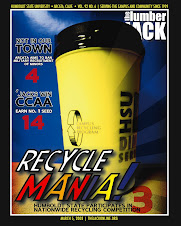
This issue was much better than the last one.
You paid attention and it shows. There were some good articles in this issue:
On Campus Housing Shortfall
Lack of Off-Campus Housing
Yell on Your Cell
Coastal Cleanup
Bad Weather and Tough Play
Having Fun With Your Furlough
I spotted some good ledes:
A tiki bar, women’s panties and scattered Playboy magazines. These are the things one would find at a college party and not on California’s coastlines. But these are just some of the items that volunteers find on trashed beaches. Good thing the annual California Coastal Cleanup Day is here to clean up the mess.
And:On a Monday evening, after a long day of school with piles of homework mounting on the floor, why would any half-sane person want to take another quiz? “I get to drink during this quiz!” said Katie Mills, a grad student at HSU studying Sociology.
I also spotted some good quotes:
“It’s the best when you have a row of little kids sitting at your feet listening with these big grins on their faces, and sometimes there’s even a few that actually have rhythm,” Isley said. This monthly event is a good way to bring the community together and experience all different types of new art.
And:
“It was a free kick on the other side of the field from me and as the ball came in I saw all the defenders shift over to the other side leaving a bunch of free space,” said Nakamoto. “I just waited to pounce on the ball if it got through and when it did I was there to punch it in.”
You came up with better headlines too
If the quality improves at the same level with each issue you will produce a great publication by the end of the term.
So here are ways to improve the next issue:
First, here is a quick guide to ledes: - Default to "You" ledes, or a descriptive or anecdotal lede.
- Question ledes rarely work.
- The "who" is never the lede unless the "who" is Jessica Simpson.
- Unless you use a "you", descriptive or anecdotal lede, the "what" is usually your lede.
- Ditch the lede you start with on your first draft and look for it elsewhere in your story.
For example, in the women's soccer story, if you ditched the first paragraph the story would start on Nakamoto's wonderful anecdote.
The free kick came in from the opposite field.
Sara Nakamoto saw all the defenders shift to the other side, leaving a bunch of free space. "I just waited to pounce on the ball if it got through," she said of her lone goal that won the game for the women's soccer team Sunday. "And when it did, I was there to punch it in."
How to handle attributions: - For your first quote, you can start the quote before the attribution. On every other quote in your story you must first introduce your new speaker before the quote.
- Place the attribution immediately after the first break in the quote.
- When transitioning to a new speaker, try paraphrasing the first part of your quote as your introduction to the speaker
Not: "Arts! is a good way to get your name out there. You ca take a demo to a vendor and if they like your music they'll let you play," Wallace said.
Instead: "Arts! is a good way to get your name out there," Wallace said. "You can take a demo..."
 Or if you needed to transition to Wallace from someone else:
 Musician Karrie Wallace said that Arts Alive! helps your get her name out. "You can take a demo to a vendor," she said, "and if they like your music they will let you play."
Use Active Verbs!
Not:
Spice was greeted by an anxious crowd that sat through...
Instead:
After a few too many opening acts, the anxious crowd greeted Spice.
Other examples of passive verbs: - ...the Northcoast Environmental Center are hosting the event...
- Thousands of sea animals are harmed every year.
- Collecting and reporting the debris not only helps the wildlife...
- For students living on campus...
- The dorm rooms are slowly deteriorating.
- ...our school is trying to expand.
- The Jacks were unable to come up with the points and were defeated by WEstern Oregon University.
When a sentence is passive there is one or more words that separate the noun and the verb. So in the first example the word "are" separates the noun " from the verb "host." That is true for the third example, although the noun "People" and the word "are" are invisible. Sometimes you can turn a sentence active by making visible those invisible words. So: When people collect and report debris, they not only help wildlife...
Show, don't tell. Here is telling not showing: Spice was timid and seemed unsure of the crowd.
Spice has lived with violence.
The teams began to get livelier, yelling out wrong answers in hopes of messing up the competition.
...the game was filled with hard tackles and highly physical play.
To figure out if you are telling and not showing, look at your verb. Suggs capitalized on a beautiful pass from Simpson and scored his third goal of the season...
Can you visualize capitalizing?
Here is another example. ...as rushed passes and the inability to put the ball in the net stopped any promising possession.
Show us how they couldn't put the ball in the net. And:
A big interception by the Wolves off Jack's quarterback Mike Peroux swung momentum out of the Jacks' hands.
Show us the big interception. So slow down when you write. You don't need to tell your reader everything. Just the highlights.

Forget the play-by-play.
Instead, focus on the best players and how they played. And focus on the strengths and weaknesses of the team and how those will help or hurt the team in the next game and the rest of the season.
But don't forget the Nut!
The nut graph is a paragraph high up in the story that summarizes all the major points. It tells the reader what the story will be about and so gives readers a reason to read to the end.
You don't need a nut graph in a story focused on only one piece of news or idea. But you need it whenever you have multiple elements.
In the Coastal Cleanup story, for example, these were the points that needed to be summarized in a nut graph: - Icky things end up on beaches
- Animals die from the trash
- Picking up trash can be fun!
- It all started at HSU but now nationwide.
- The cleanup project finds wierd stuff.
- It is amazing how much garbage the project finds
If you have a good nut graph you will have a well-organized story.
Try writing your nut graph first, not last. To do that you will have to outline your story.
Delete the dull so it doesn't bury the good stuff
Here is an example:

When asked to explain Arts!, David Isley said, "It's a gift to citizens and patrons."
Now that is dull. What followed was much more interesting:
Isley is a music teacher who plays seven instruments including the guitar, banjo, mandolin, and fiddle.

When you think you are done, try flipping the whole story. Writers tend to write backwards.
Kill those adverbs.
They weaken, rather than strengthen your copy.
While College Creek will provide desperately needed on-campus living space...
Kill hyperbole and strengthen generic terms
Words like "unparalleled, "very", "incredible," and "unique."
Understatement is more effective than overstatement. Remember that readers tend towards skepticism. So if you understate they believe it is bigger than you say. If you overstate they believe it is less.
End your stories with a bang!
To do that you need to think as much about your kicker as you do your lede.
Break apart run on sentences.
The Jacks continued to battle back into enemy territory until kicker Kyle Scheierholt was sent in for a field goal, ending teh first half with 3-3 tie.
Consider how many things you smushed together in one sentence: - The Jacks battled back into enemy territory.
- The coach sent in kicker Kyle Scheierholt for field goal.
- That ended the first half with a tie of 3-3.
 Improve your sourcing
In some stories you need to seek out sources most relevant to your story
In a story about Rosh Hashonah, it doesn't help the reader to interview people who know nothing about the holiday.
In others you need to diversify. So while the Word on the Street is informative and entertaining, it does not reflect the diversity of the campus.
 Box the fun stuff
They don't have to be just for essential information. Stick in a box the wierd stuff found on the beach during cleanup day. Or the questions and answers from Quiz night.
If you have fun with the information you collect, the reader will have fun reading your publication.

In the class critique some students said they liked:- The editorial
- The cover
- The perilous plunge photo essay
- The hard hitting stories
- The improved layout of the forum section
Some students said they didn't like:
- That the cover exaggerated the budget problem
- That you praised the 'Jacks in the editorial but gave them short shrift in the sports section
- That too many stories lacked art.
This was clearly the best issue of the term.
It had hard-hitting stories, clean copy and it looked great. But you still show problems with: - Buried ledes
- Transitions between speakers
- Stories that read like press releases
- Boring headlines
- Story organization
- Making your stories compelling
- Grounding your reader
Let's take a close look at the cover story
This was a well-reported story, chock full of good information. But it suffered from two problems:Poor organization and passive phrasing.

Remember the Burstiner Mantra:
What's the story?
Is the story about a budget? No, because the reader doesn't care about a budget. Instead the story is all the things the students, staff and faculty willlose because the state will shortchange the school once again. So the lede isn't the school faces uncertainty or that it learned some bad news. The lede is located in at the bottom of the third column, smack in the middle of the story:

Try moving your paragaphs around on second draft:
Next fall, expect HSU to eliminate some courses you might need, layoff professors you might like, and end services you might depend on. Expect even more crowded classes and higher student fees. That's because while the school expected to get almost $5 million more next year than it did this year, it now expects to get less. A lot less.
But if you are here, you're already enrolled. If you've got a brother, sister or cousin planning on coming in the fall, consider this: The budget cuts will force CalState to close the doors to some 10,000 students it could otherwise let in.
Each of the 23 CalState campuses is in this same financial boat. They've already swallowed a total of more than $500 million over the past eight years; that's almost $22 million per campus.
And despite the cuts, Humboldt State must still pay for increased costs of such things as utilities and salaries.
That means that the cuts must come elsewhere.
Passive phrasing dulled this issue:- Humboldt State was notified...
- Humboldt State is facing...
- The proposal was for a cut...
- Humboldt State was expecting to receive...
Careful how you include numbers in a story.

Too many digits break up copy flow and send readers to less tedious stories. It doesn't matter to most readers whether the story is about $4.7 million or $4,747,000. But the first number requires them to read five words (four point seven million dollars) while the more precise number takes nine words: Four million, seven hundred and forty seven thousand dollars. For more on how to use numbers in your articles, see this story.
Don't bury your ledes.
- The flu hits Humboldt: The lede was Kelly Ridgeway who came to school to take a history exam even though she was sick only to find people hacking all around her and who had the professor cancel two classes the next week because she was sick.
Meanwhile the kicker for that story was Stephanie Burkahlter who called it Deathbed 2008. - Horses: The lede was how in 2003 Sara Isaacson bought a quarterhorse who had gashes across his chest from being whipped.
- North Coast Parents: The group offers members a week of free meals to members when they give birth. That's pretty nifty and might call for a YOU lede: If you are in your fifth month of pregnancy consider joining Northcoast Parents. When the doctor delivers your child, they'll deliver a week a free meals. That that's just the beginning of the support the group offers.
To begin the story that way, changes the whole story. It forces you to listen to something said as an aside and zero in on what it means. Because you then ha ve to ask: How does that work? A week worth of meals is 21 meals, does that mean that 21 different people each take a meal and drive it to Lolita if that's where the new parent lives? Does each member take a three meal day? Do they just call 21 different food delivery places and pay for delivery? A week of free meals takes five words to mention, but the coordination and volunteer time behind those five words takes a whole story to explain. And it gives you the opportunity to talk to the people who received these meals in the past and the committed volunteers who help organize and carry it out.
Some stories ended with nice kickers
 But try breaking up your quotes for better effect:
 "I'm glad they're having an event like this, I can't wait to go and stuff myself," Moreno said.
Instead:
"I'm glad they're having an event like this," Moreno said. "I can't wait to go and stuff myself."
The same with this nice kicker: But she also helps for the simple reason of loving them. "Just being next to one of these animals, cleaning its poop or whatever, settles my heart and mind," Zarnes said.
Instead: "Just being next to one of these animals, cleaning its poop or whatever," Zarnes said, "settles my heart and mind.
 Don't catch yourself churning out press releases.
When you must use a press release to generate an idea for a story, view the release the same way you would an event you must cover. The event isn't the story; neither is what is on the release, at least not unless the release is about a vitally important piece of news.
The story is something else that touches people. So take a press release and look for the real story behind it. So a story about Patty Berg winning an award is not a story about Patty Berg or the award. It is the reason she won it, which is a bill that allows dying people to take control of where and how they die. How difficult was it for Berg to get that passed? What opposition did she face? How did she overcome it? What will she do now to further this type of legislative agenda? That's the story.
That means that either the headlines, the lead or the body of the story didn't give the story the life it deserved.
Take the story about the mediation group.
It is a story about a group of people who joined a non-profit (translation: they aren't in it for the money) to jump into arguments most people avoid. But the arguments they mediate are not the story here so your problem is that you have a story without conflict. Instead what makes it interesting is the contrast between what is normal or expected and what you present. This is known as the
Man bites dog story
 The reader expects a dog to bite a man. But for a man to bite a dog is the opposite of what you'd expect.
Anytime you suspect you have a boring story to report look for unexpected contrasts: A rich person helping out poor people, a timid person who's a monster on the football field.
For a good example, look at the story on Sunshine week, which the reader might expect to be a glowing story about how much Congressman Mike Thompson is doing to promote transparency in government. Instead it begins with how hard it is for regular citizens to talk to a congressman, and the contrast between the ability of Thompson versus the normal person to access government info.
Ground your reader
The story about Jason Robo was confusing even if you knew a little abou t Jason Robo. Without knowing anything it seems as if the AS kicked off a guy for missing two meetings. That doesn't make sense. It mentions that he aired dirty laundry but it doesn't explain. You can't talk about dirty laundry without showing the dirt. Also you mentioned that he is active with NORML but you don't explain what that is and the little old lady in Fortuna has no idea. Meanwhile you left out that he is as active with 911Truth and that gets him labeled as an anti-government conspiracy theorist.
Paraphrase lousy quotes:
"The best time to apply is the beginning of your senior year."
Why should that be in quotes? Use quotes when someone says something better than you can say it (and remember, you are the writer with the power of words).
"Baloney!," she said the week before the fatal accident. "It'll happen over my dead body."
Finally...
Nice job on editing.
This was the cleanest issue in terms of typos and grammars all year.
Email me!
at mib3@humboldt.edu
Marcy's Top Ten Rules
1. Use active verbs.
2. Don't be afraid to paraphrase.
3. Question the answers to the questions you ask.
4. Substance always adds to style.
5. Honesty overrides all other journalistic rules.
6. Accuracy is not the same as truth.
7. Getting two sides to a story is not the same as balance.
8. Show don't tell.
9. Write with all five senses.
10. Give voice to the voiceless.
Movies about newspaper reporters
- Futureworld
- Salvador
- The Return of Doctor X
- Missing
- All the Presidents Men
- Scoop
- The Quiet American
- Foreign Correspondent
- Gentleman's Agreement
- Under Fire
- The Parallax View
- The Mean Season
- Defense of the Realm
- Superman 1-7
- The Front Page
- His Girl Friday
- The Year of Living Dangerously
- The Killing Fields
- Inherit the Wind
- True Crime
- The Paper
- Deadline-USA
- Call Northside 777


 Or if you needed to transition to Wallace from someone else:
 the Nut!

 that you need to think as much about your kicker as you do your lede.
 Improve your sourcing