
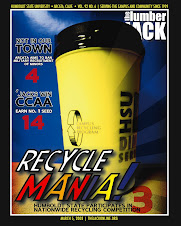
 Good issue, lousy cover. The headline took a great story idea -- bruiser chicks -- and made it boring. This story wasn't about a roller derby team competing for charity. It was about a bunch of babes who get inside a roller rink and pummel each other for points. Don't overstate or overhype, but don't downplay the fascinating.
Great job on the debate.
It was the most professional city council debate I've seen. You presented good questions and paced them just right. You drew a decent crowd and received the respect of each candidate. Great teamwork and organization.
The story you published on the debate, well that was another story. You presented good information, but you did so in the wrong format. You tried to write the story in a linear fashion, but that dulled it down.
A better approach: Break out each issue and then summarize the various
 positions. There was quite a bit of agreement among candidates. By breaking out each issue with a visible subhead, you would give your readers multiple entry points into the story. You would lure more people into the story this way. Better yet, you could lay the story out as a chart with the different issues as rows and the candidates positions in the columns.
Don't dull down your story
The mud snail story was an interesting subject and you gave it a good headline. But you dulled it down:
First, leave attributions out of the lede. You can attribute the information in the second paragraph
Second, shorten your paragraphs.
Third, kill repetitions. You wrote: Fish and Wildlife Service fish and wildlife biologist Greg Goldsmith.
Fourth, make your sentence active.
You wrote: It is believed to be the first North Coast sighting since the snails were discovered in North America in 1987.
Instead: The snails first appeared in North American in 1987 but stayed clear of the N
 orth Coast until now.
 Last, don't bury your lede. I found it smack in the middle of the story. The Wildlife Service wants the public to clean boats off to minimize the snail spread. So here is your lede: Hey you with the kayak! Clean off your boat when you finish paddling around. Otherwise you will aid and abet a snail invasion.

Map your stories on Google Maps
The story about the Oaxaca exchange begged for a map. Help your readers visualize the place you talk about. You can embed the map onto the site (see your editor), print it in the paper or link your readers to the map you saved on Google MyMaps.
Don't forget the real people!
The Oaxaca story also begged for a student who expects to go on the trip.
Help your readers get involved!
 Box information that lets them know how they can participate or how they can help. The most interesting tidbit of information in the story was that Susan Cooper collected 12 digital cameras as donations off Craig's List. You never know when some crazy rich person might pick up the Lumberjack or stumble on your story on the Web whip out a checkbook. You can literally change people's lives in that manner: Your story can act as the liaison between the have's and the have nots and between those who can solve the problems for the people who have the problems.
Give your readers info they can use even on the lightest story. You needed to tell readers, for example, how and where they could get the new Womama CD.
Ground your readers
 The story about how HSU faculty won't discuss the subject of racism, you didn't first establish in the story that there is racism at Humboldt State. You can't expect your readers of this story
to have read the last story you did on it. You needed to include at least one paragraph that refers readers to the last story and reestablishes that the Lumberjack interviewed numerous students who said they felt harrassed and discriminated against on campus.
You made the same mistake with the editorial. You say students are subjected to racial prejudice but no where in this issue did you show that.
Use your electronic media to give readers deeper coverage
 One problem is that you fail to make adequate use of your Website. In the story and editorial you could have referred readers to the former story. On the Website you should have tagged a link to the last story onto the bottom of the new story.
When doing ongoing coverage, make readers aware that the latest story is part of a series. Box all the headlines for the linked stories with the date and a short summ
 ary. It will tell readers you are on the ball.
But when boxing your info be careful
The print inside the info box on the council candidates was too small to read. Even as you remember the blind reader you forget the ones with poor eyesight.
Good story on PowerVote
This election will be historic; you want to take every opportunity to remind readers to vote and help them do that.
But once again you wrote the story...
sdrawkcaB
The PowerVote folks gathered 700 signatures from people who pledged to take clean energy issues into account when casting their ballots. That's a lot of signatures to gather on this campus, but you buried the info in the middle of the jump. Also buried was the info that the organizers get course credit for doing that, which I think might be a story in itself. That means that a public university is giving course credit for political campaigning.
And don't forget that the delete key is your friend.
I put a slash mark through one full paragraph and half of a second paragraph. After you write each paragraph try deleting it and see if it makes any difference. If it doesn't don't put it back in.
You dissed that poor delete key on the slackline story as well. It was a nice story, but it didn't warrant the jump.
Did I tell you to not bury your ledes?
That's what you did in the soccer story. I found it in the first paragraph of the jump:
For much of Friday night, Cal Poly Pomona kept the soccer ball close to their goal. But with just under 10 minutes left, Lumberjacks freshman Karen Pontoni took a pass from sophomore Danielle Drucker and put it into the net. The 2-1 win was the women's first since Sept. 21 against San Francisco State.
You also buried your lede on the KSLG story. I found it at the end of the second column when I discovered that she joined the station at age 16.
Focus your stories
The story on KSLG/Monica Topping would be a good story if it were about one or the other. But it read as if you couldn't decide which to profile. The result is that the reader doesn't get enough of either. When readers want news as tapas, they go to the briefs page. When they start to read a feature they expect a full entree.
Great job on the roller derby story!
- You showed instead of told
- Beautiful lede.
- Nice kicker.
- You filled story with action
- You introduced us to real people.
- You gave us the news angle (charity event) but didn't make the story about that.







No comments:
Post a Comment