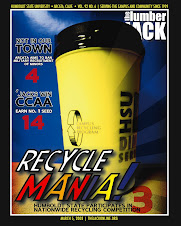
This issue was much better than the last one.
You paid attention and it shows. There were some good articles in this issue:
On Campus Housing Shortfall
Lack of Off-Campus Housing
Yell on Your Cell
Coastal Cleanup
Bad Weather and Tough Play
Having Fun With Your Furlough
I spotted some good ledes:
A tiki bar, women’s panties and scattered Playboy magazines. These are the things one would find at a college party and not on California’s coastlines. But these are just some of the items that volunteers find on trashed beaches. Good thing the annual California Coastal Cleanup Day is here to clean up the mess.
And:On a Monday evening, after a long day of school with piles of homework mounting on the floor, why would any half-sane person want to take another quiz? “I get to drink during this quiz!” said Katie Mills, a grad student at HSU studying Sociology.
I also spotted some good quotes:
“It’s the best when you have a row of little kids sitting at your feet listening with these big grins on their faces, and sometimes there’s even a few that actually have rhythm,” Isley said. This monthly event is a good way to bring the community together and experience all different types of new art.
And:
“It was a free kick on the other side of the field from me and as the ball came in I saw all the defenders shift over to the other side leaving a bunch of free space,” said Nakamoto. “I just waited to pounce on the ball if it got through and when it did I was there to punch it in.”
You came up with better headlines too
If the quality improves at the same level with each issue you will produce a great publication by the end of the term.
So here are ways to improve the next issue:
First, here is a quick guide to ledes: - Default to "You" ledes, or a descriptive or anecdotal lede.
- Question ledes rarely work.
- The "who" is never the lede unless the "who" is Jessica Simpson.
- Unless you use a "you", descriptive or anecdotal lede, the "what" is usually your lede.
- Ditch the lede you start with on your first draft and look for it elsewhere in your story.
For example, in the women's soccer story, if you ditched the first paragraph the story would start on Nakamoto's wonderful anecdote.
The free kick came in from the opposite field.
Sara Nakamoto saw all the defenders shift to the other side, leaving a bunch of free space. "I just waited to pounce on the ball if it got through," she said of her lone goal that won the game for the women's soccer team Sunday. "And when it did, I was there to punch it in."
How to handle attributions: - For your first quote, you can start the quote before the attribution. On every other quote in your story you must first introduce your new speaker before the quote.
- Place the attribution immediately after the first break in the quote.
- When transitioning to a new speaker, try paraphrasing the first part of your quote as your introduction to the speaker
Not: "Arts! is a good way to get your name out there. You ca take a demo to a vendor and if they like your music they'll let you play," Wallace said.
Instead: "Arts! is a good way to get your name out there," Wallace said. "You can take a demo..."
 Or if you needed to transition to Wallace from someone else:
 Musician Karrie Wallace said that Arts Alive! helps your get her name out. "You can take a demo to a vendor," she said, "and if they like your music they will let you play."
Use Active Verbs!
Not:
Spice was greeted by an anxious crowd that sat through...
Instead:
After a few too many opening acts, the anxious crowd greeted Spice.
Other examples of passive verbs: - ...the Northcoast Environmental Center are hosting the event...
- Thousands of sea animals are harmed every year.
- Collecting and reporting the debris not only helps the wildlife...
- For students living on campus...
- The dorm rooms are slowly deteriorating.
- ...our school is trying to expand.
- The Jacks were unable to come up with the points and were defeated by WEstern Oregon University.
When a sentence is passive there is one or more words that separate the noun and the verb. So in the first example the word "are" separates the noun " from the verb "host." That is true for the third example, although the noun "People" and the word "are" are invisible. Sometimes you can turn a sentence active by making visible those invisible words. So: When people collect and report debris, they not only help wildlife...
Show, don't tell. Here is telling not showing: Spice was timid and seemed unsure of the crowd.
Spice has lived with violence.
The teams began to get livelier, yelling out wrong answers in hopes of messing up the competition.
...the game was filled with hard tackles and highly physical play.
To figure out if you are telling and not showing, look at your verb. Suggs capitalized on a beautiful pass from Simpson and scored his third goal of the season...
Can you visualize capitalizing?
Here is another example. ...as rushed passes and the inability to put the ball in the net stopped any promising possession.
Show us how they couldn't put the ball in the net. And:
A big interception by the Wolves off Jack's quarterback Mike Peroux swung momentum out of the Jacks' hands.
Show us the big interception. So slow down when you write. You don't need to tell your reader everything. Just the highlights.

Forget the play-by-play.
Instead, focus on the best players and how they played. And focus on the strengths and weaknesses of the team and how those will help or hurt the team in the next game and the rest of the season.
But don't forget the Nut!
The nut graph is a paragraph high up in the story that summarizes all the major points. It tells the reader what the story will be about and so gives readers a reason to read to the end.
You don't need a nut graph in a story focused on only one piece of news or idea. But you need it whenever you have multiple elements.
In the Coastal Cleanup story, for example, these were the points that needed to be summarized in a nut graph: - Icky things end up on beaches
- Animals die from the trash
- Picking up trash can be fun!
- It all started at HSU but now nationwide.
- The cleanup project finds wierd stuff.
- It is amazing how much garbage the project finds
If you have a good nut graph you will have a well-organized story.
Try writing your nut graph first, not last. To do that you will have to outline your story.
Delete the dull so it doesn't bury the good stuff
Here is an example:

When asked to explain Arts!, David Isley said, "It's a gift to citizens and patrons."
Now that is dull. What followed was much more interesting:
Isley is a music teacher who plays seven instruments including the guitar, banjo, mandolin, and fiddle.

When you think you are done, try flipping the whole story. Writers tend to write backwards.
Kill those adverbs.
They weaken, rather than strengthen your copy.
While College Creek will provide desperately needed on-campus living space...
Kill hyperbole and strengthen generic terms
Words like "unparalleled, "very", "incredible," and "unique."
Understatement is more effective than overstatement. Remember that readers tend towards skepticism. So if you understate they believe it is bigger than you say. If you overstate they believe it is less.
End your stories with a bang!
To do that you need to think as much about your kicker as you do your lede.
Break apart run on sentences.
The Jacks continued to battle back into enemy territory until kicker Kyle Scheierholt was sent in for a field goal, ending teh first half with 3-3 tie.
Consider how many things you smushed together in one sentence: - The Jacks battled back into enemy territory.
- The coach sent in kicker Kyle Scheierholt for field goal.
- That ended the first half with a tie of 3-3.
 Improve your sourcing
In some stories you need to seek out sources most relevant to your story
In a story about Rosh Hashonah, it doesn't help the reader to interview people who know nothing about the holiday.
In others you need to diversify. So while the Word on the Street is informative and entertaining, it does not reflect the diversity of the campus.
 Box the fun stuff
They don't have to be just for essential information. Stick in a box the wierd stuff found on the beach during cleanup day. Or the questions and answers from Quiz night.
If you have fun with the information you collect, the reader will have fun reading your publication.
 What you did well in this issue:
You produced a number of serious, timely stories on important. There were many stories here that had the potential to be cover stories.
There was also some great art, particularly the center spread for the Gay Pride Parade.
Nice cover, as well.
But there was much room for improvement.
1. Be relevant to your readers
It was good that you covered Rollin Richmond's Q&A session with students, but you took seven paragraphs before you got to the actual questions and his answers. You made the mistake of covering the event as an event. The reader cares most about what Richmond said and what questions from students he evaded.
Keep your language simple and too the point.
My first YIKES! of the term went to this sentence in the story F the Furloughs:
These regressions are the result of mandated furlough days higher educational institutions across the state were required to implement due to the massive state budget deficit.
In other words, just spit it out!
Show don't tell.
Imagine that your reader can't see, so a photo won't do. You must describe what you m ean.
ean. - Don't tell us Tony Ramirez is a talented midfielder, show us.
- Don't tell us that many of the participants in the Gay Pride Parade wore colorful costumes. Describe the colorful costumes.
- Don't tell us the audience at the Black Joe Lewis concert danced themselves to exhaustion, describe people dancing to exhaustion.
Don't bury your ledes or hide your kickers
After your first draft, look for a better lede within the story. It usually hides in the third paragraph from the end or smack in the middle of your piece.
In the story about i ntramural sports the lede is that Jan Henry thinks that if you study hard but don't play hard, you only get half an education.
In Gritty, Not Pretty, it was that if you mix Chuck Berry with Iggy Pop you get Black Joe Lewis.
- In the story about the ROSE center it was that students can get free office supplies.
- In the bloodmobile story, it was that Ben Smith donates more than three quarts of his blood every year.
- In the swine flu story it was that if you share a bong with a friend, the high you get will last you two hours but the flu you might catch will last a week.
Use active verbs
 Active verbs power up the story and speed the reader through as story. Passive verbs deflate the story and slow the reader down.
Not:Multiple leagues are provided...
Instead:
The university provides leagues in most sports.
Not:
While students are paying more for their education, they are attending classes less...
Instead:
While students pay more for their education, they attend classes less.
Not:
Among the people who know about it, the program has proved quite popular.
Instead:
People who use the ROSE center love it.
Not: The intramural sports office is allowing people who are restricted...
Instead:
If you can't enroll in more classes you can pay $2 per team.
Not: If you are interested in joining a team then you should act soon.
Instead:
If you want to join a team, act soon.
To make a passive sentence active try and flip it. There is a good chance you wrote the sentence backwards.
Keep quotes sh ort
ort
Compare: "Originally, I started playing maybe my freshman, sophomore year when I was actually living in the dorms," he says. " A bunch of my friends wanted to play and I was looking for a sport to play. I played soccer and softball. It was the first time I played softball, ever, and it was a blast. I had a great time doing it."
To: "I started playing maybe my freshman, sophomore year when I was actually living in the dorms," he says. "It was the first time I played softball, ever, and it was a blast."
Fish for quotes with personality.

To do that you need to pull anecdotes out of your sources.
In the story about Allison Lawrence, star soccer player, Lawrence says that her dad coached her at age four.
Here are the questions that would pull out the anecdotes: How did your dad's coaching style compare to that of your current coach? Who was the best coach you ever had and what made him so great?
And ask your source to make a comparison or ask for bests, worsts, firsts, and lasts of something. Those questions force people to think about things that happened to them and pull those memories out of their brains. Spice up a dull story with anecdotes.
Ask for specifics.
Off the field Allison Lawrence enjoys spending time with her friends and family -- who exactly? Best friend Jill Jones? Big sister Jamie who is three years older? Brother Tony who she is really competitive with? Mother who she gardens with?
Ask how and why
If someone says the rock band was killer, ask: "How were they killer?"
If someone says the program is useful, ask: "In what way?"
Or to get a good quote try playing Devil's Advocate.
If someone says that playing intramural sports is fun, you might try saying: "Really? Because I was under the impression that it is really time consuming, what with all that practice and all..."
That prompts the source to say, "No way! There are no practices and when we get together its just a great time. After the stress of classes and tests its a great way to clear your head and blow off steam."
Focus your columns around ONE idea
Column 1: Hector Diaz and students like him: What is it like couch surfing or car sleeping? How many students out there? Who can help him?
Column 2: Rental management companies and how they treat
Column 3: How HSU compares with other schools on providing upper class housing.
Column 4: Arcata's discouragement of student housingNever accuse without evidence.
You say in Deranged that HPM has little to not time to show units to interested students.
But how do you know that?
So also...
Source all info
It was good that you ran an obituary for Michele Keys, but the information in the article was not sourced. Who said she had an inescapable enthusiasm for adventure?
And in the Foster Farms story, who said that Foster Farms will undoubtedly benefit from the purchasing of the small dairy -- because as a I reader I tend to doubt. And who said that its high end produce is used in many products?
Kill clichés and redudancies

Here's the cliche: One of the remaining flagships of Humboldt County's locally-owned and operated businesses has sailed...
Here's a redundancy: Lewis smiled with satisfaction as he strut about the stage with confidence.
You don't strut with insecurity. Strutting is showing confidence. Don't repeat.
Congratulations to all 'Jackers!
You got through another tough year. While it is tradition to not critique the last issue, there is no law against my telling you that you produced a big issue filled with substantial, relevant stories.

Okay, now I can slam the previous issue.
Problem #1: News judgment.
The big story is the one that immediately concerns students. That's the question of how they can afford college. You placed that under the fold on page three and made Take Back the Night the cover story. While sexualized violence is an important issue, the event is held every year.
Problem #2: Wordiness
You need to tighten your writing. Look at the lede on the affordable college story:
The "American Dream" has seemingly become a far cry from apple pies and baseball game. For college students, education once was inexpensive in California, but it has become almost impossible to afford.
 Here's what tightening does:
College education once was inexpensive in California. Now few can afford it.
In comparison, you had some nice tight stories on the upcoming special election and whale watching, both done by the same person.
Problem #3: Ask, "what's my story?"
That's what you needed to do with the college affordability piece. At least that's what readers think the story is about until you introduce them to Johanna Bradfield. She got a great tax deduction because she married her same sex partner. But the federal government doesn't recognize same sex marriages and this discrepancy isn't addressed in the story, so it becomes confusing and ends up distracting from the point of the story, which is college affordability.
 And you start the dam story by telling readers that a battle is being waged along the Klamath River. But then you fail to give readers a battle. Instead you have consensus that the dams should come down, but some dissatisfaction about the means and timing for doing so.
You also missed the story in the article about KMUD. Here is a community station in the middle of nowhere in the heart of marijuana country. But you wrote it as if its just another community radio station. The problem was one of conflict. As someone who volunteers at the station and has a radio show on it, you failed to see it from the perspective of an outsider. At the least, you needed a disclaimer that you work at the station. But someone else should have reported and written this story.

Problem #4: When covering an event, the event is not the story.
Understand the difference between the news angle and the news. The news angle is the excuse for doing a story you want to do, or a reason you can explain to the reader why you are doing the story now. So you need to find the story when going to an event like SLAMfest. Because readers don't care about an event they didn't go to.
You had the same problem with the profile of the Entrepeneurship Club. Readers don't care about a club. You have to make them care about the people behind the club or something super interesting the club does. But you did neither in this story.
Problem #5: Overkill.
Okay, so you should have put a "paid advertisement" tag on top of the holocaust denial ad. You decided not to allow it to run again. You welcomed comments and found space for many of the letters and referred readers to the rest of the online. But to say that the Lumberjack made a "horrible" mistake went a little overboard.
Problem #6: You need to question the answers to the questions you ask
The profile of Megan Rolland was a nice job and has a nice lede. But you need to ask "how?" and "why?" all the time.
She said: "Back at home when you were that young you couldn't do any other sports but cross country." Why?
You say: At the level Rolland is running and competing at, it starts to affect the body. How does it affect her body? Exactly what hurts?
And where will the Nationals take place.
Nitpicky stuff: - Don't use "according to" except for data you didn't collect yourself. It signals to readers that you have reason to doubt the information.
- Keep your paragraphs short. The college affordability story was filled with paragraphs that were too long.
Sometimes trouble hits you when you aren't looking.
That's what happened last week when the Lumberjack ran an ad on page four in the April 15 issue from someone purporting to seek people who could prove that anyone had been killed in a gas chamber at Auschwitz. In other words, it was run by someone who denies the Holocaust happened and who hopes to convince others.
Holocaust denier Bradley Smith has had a long history of trying to spread his message through college papers. These ads have appeared in the Lumberjack at least twice before, but not in recent years.
While HSU has given students the right to control the editorial content of the paper, until now it has not given them you the right to control advertising content. That power rested with the business manager and the journalism department.

But in 2006, the state legislature passed AB 2581 which prohibits any public college in California from censoring student newspapers. The Student Press Law Center believes this includes advertisements. So now students can decide whether or not a controversial ad will run.
With this power comes responsibility. You found this out last week, when the rabbi of Temple Beth El in Eureka asked members of her congregation to write letters to the Lumberjack protesting the publishing of the ad. Some 2o letters are running in the April 29 issue. Had you reacted with inconsideration you would face the prospect of a protest rally outside your windows and possibly a boycott by your other advertisers.
You chose instead to welcome the letters, run an apology to readers for your failure to adequately label the advertisement as a paid ad, and you decided to turn down Mr. Smith's request to run the ad again.
These are tough decisions to make.
But let's get back to the April 22 issue.
You had some nice features in this issue, particularly the Oliver profile, the Art Gone Wild, the ice cream story and the tennis club profile. But except for the 420 photos, the ice cream photos, the wild art shots, the art was dull and the pages gray. The art photos could have been bigger. And don't use stock photos for sports unless the story is a profile.
You started many of the stories with strong ledes:
Between the lipsynced performances, glittering outfits and the occasional penis peek-a-boo, the Night of Drag Show had the audience laughing so loud it took a few minutes for the room to stop echoing.
We all have our secrets, but some secrets should not carry the burden of fear.
Bounce. Smack. Bounce. Smack. The sounds echo across the courts as you prepare your next move. Snap. The ball hits the net, and a point is lost. A loud groan leaves your opponent's gritted teeth. You have won.
It took three bullets to instantly change Travon Oliver's life forever.
But see in the last two examples how you can make your writing more powerful.
Three bullets changed Travon Oliver's life.
A loud groan leaves your opponent's gritted teeth. You won.
And a little tightening improves the SLAMfest lede too:
You are driving down by the Arcata Bottoms and you see an omnipresent glow on top of the hill. You wonder what that glow could be, and for a brief moment it reminds you of a scene from E.T.
You drive down by the Arcata Bottoms and you see a glow on top of the hill like a scene from E.T.
After you nail the lede, you need to slow down.


You rushed through the Drag Show story. You mention Sir Mix-A-Lot, but the little old lady from Fortuna doesn't know who that is.
And then you tell us about Ana Kolpin who gets spanked for money, but you don't explain how she raises $150 in donations. The story was confusing: Was this a story about a Drag Show for the Day of Silence or a story about a student trying to raise money for the AIDS ride?
The SLAMfest story was also a mess.
You talk about Relight Redwood Bowl but you don't ever explain what that is.
Much clearer was the story on the Day of Silence.
The interview via notes was very effective. You might have had Maria Melnik rip out one of those sheets and scanned them in for a graphic.
Don't misuse commas!
See the comma guide on the side of this page.
It showed potential students and their parents, that all students are accepted and respected for who they are at HSU.
You needed a comma after students or you needed to take out both the comma and the word their.
It showed potential students, and their parents, that all students are accepted...
It showed potential students and parents that all students are accepted.
Meanwhile, the misused comma was only one problem in this mangled sentenced.
Those who have seen protests from the Civil Rights era to the war in Vietnam, understand that one recurring theme is if there is any way to reach people, it is by getting them to think.
AP Style doesn't say to capitalize civil rights anything. And where are those people who saw protests? Not the writer of the story and not the people he interviewed for it. And the sentence makes no sense.
So ask yourself:
What am I trying to say?
Then say it.
Don't bury your ledes
In the story on Summer L.E.A.P. I found the lede at the top of the second column.
Derek Hancey can't seem to get out of the water.
AA stands for Avoid Acronyms.
Instead of referring to Summer L.E.A.P. with the acronym, after the first reference just say the leadership program or the adventure program. Visually, acronyms disrupt copy flow.
The same went for the No means No story. Instead of NCRCT Client Services Coordinator, just say Maryann Hayes-Mariani, client services coordinator for the rape crisis team,...
Hyperbole is horrendous!
Merriam-Webster defines hyperbole as extravagant exaggeration.
So be careful how you describe things:
Student-led activities, like the protest held by the network and members of the Queer Student Union, demonstrate the epitome of student activism in human rights...

I would say that standing in front of a tank in Tiananmen Square is the epitome of student activism. Keeping silent in the HSU Quad doesn't come close.
Delete dubious information.
You begin a paragraph in the Take Back the Night story this way:
Take Back the Night at HSU has a somewhat unknown timeline.
If I were editor, I'd have killed that whole section. Meanwhile, you needed to break out story about Cheri Honkala.
Be curious. Ask questions.
 In the Pell Grant story:
How many HSU students get Pell Grants?
How does one qualify? What are the criteria?
In the ice cream story:
What was in the shop before?
How much did they have to invest to open up the place?
Don't write backwards.
That's what you did with the film festival story. The kicker was your lede:
If you don't catch the 30 international films that will be screened at the 42nd Humboldt Film Festival this week, chances are that you won't ever see them.
Avoid the play by play
That's what you did with the baseball story. Instead, focus on the three best plays, slow down the action and take your readers onto the field.
Instead, I found the story near the end of the jump. The Jacks now sit 6-5 in the national Club Baseball League. They hope to pull off another sweep next weekend against Santa Cruz. That would put them in second place in the league and could get them a spot in the playoffs.
The rugby story showed how it is done, only try not to mix your metaphors
The Middlebury forward pitched the ball and the Jack's defenders proceeded to tackle him. He lowered his steel-like shoulder and bounced off player after player like a ping-pong ball.

Is he made of steel or is he a ping pong ball?
 Don't promise what you can't deliver
The cover looked great but the story disappointed. Never promise or tease the reader with something that you can't deliver. The cover promised a story about a problematic switchover from WebRe g to Student Center, but you only had some mild complaints in the story.
The problem was that you missed the story. You bury and brush over this:
- That the software cost HSU $14 million
- That the reason the school had to buy it was that the chancellor forced it on all CSU's
- That it is made by a company called PeopleSoft.
What you didn't mention is that there are 23 campuses in the CSU system and HSU is one of the smaller ones. That means that PeopleSoft/Oracle is pulling in more than $300 million on this software transition. For that price it should be problem free software.
This could have been a great story. Next time you need to...

Do your research
If you had done a basic news background search on LexisNexis or Factiva, you would have found story after story about problems at other CSU campuses.

If you don't know how to do basic research you need to sit down with a reference librarian at the library. They will show you the great databases the library offers (which you can access from any computer) and how to use them. Once you graduate, databases like LexisNexis and Factiva cost so much money, few newspapers give their reporters access to them.
I still found errors in this issue:
Staff Wrier
23 CSU's
People Soft
Who instead of which
Her instead of her
kids used as a reference to children
This years focus
Don't confuse your reader
I drew question marks in the margins of several stories. And that was the real problem with this issue.
Take for example the lede to the light bulb story:
LED lights are light everyday household items like digital clocks, remote controls and even the red stop light you almost ran through today.
I had to read that sentence three times and I still didn't get it.
In the same story you started one paragraph this way:
President of C. Crane Co. Rob C. Crane, discussed the creation fo the GeoBulb...
But you never told me about any C.Crane Co. so I didn't know who the heck this guy Rob C. Crane was or why he was in the story.
Then there was the profile of Julie Sheppard. She is separated from her twin for only one month of her life. But she's f rom Los Angeles, and her twin just graduated from HSU and convinced her to enroll. So did she just hang out with her sister while the twin went to college? Or did the twin get a four year degree in one month? I couldn't figure it out.
In the Plan-It Green story you mention Winzler and Kelly and the reader doesn't know who those two guys are or that it is the name of a local company.
And in the Men's Rugby story you have this sentence:
With Pleasant being a big factor in the 15 on 15 goal line stand, he is humble and looks forward to nationals.
What's a 15 on 15 goal line stand?
 So SLOW DOWN
Take your reader slowly through the elements in the story. After each sentence ask yourself two questions:
Does the reader need to know this?
Will my reader be confused by this?
Meanwhile I still found way too much passive phrasing in your stories.
Not:
Making sure that its clients are well-fed is a main priority.
Instead:
The Endeavor's main priority is to keep its clients fed.
Not:
A number of the photographs were taken by A.W. Ericson...
Instead:
A.W. Ericson took a number of the photographs.
Keep it short
Your editorials are too wordy. You use an awful lot of words and space for a simple message: The school spent too much money for a new software program.
There was some nice showing in this issue.
Scott shook left, opening a little space for himself, then picked up speed and lowered his shoulder into a Western Oregon defender. The crowd was silenced as he moved his legs like a locomotive.
You asked some good questions in this issue but you need to...
Question the Answers
When you asked Slattery if she liked her experience at Humboldt she said: "Kind of, but not really."
But then you move on to a new question altogether, leaving the reader to wonder what about Humboldt Slattery doesn't like.
.
Email me!
at mib3@humboldt.edu
Marcy's Top Ten Rules
1. Use active verbs.
2. Don't be afraid to paraphrase.
3. Question the answers to the questions you ask.
4. Substance always adds to style.
5. Honesty overrides all other journalistic rules.
6. Accuracy is not the same as truth.
7. Getting two sides to a story is not the same as balance.
8. Show don't tell.
9. Write with all five senses.
10. Give voice to the voiceless.
Movies about newspaper reporters
- Futureworld
- Salvador
- The Return of Doctor X
- Missing
- All the Presidents Men
- Scoop
- The Quiet American
- Foreign Correspondent
- Gentleman's Agreement
- Under Fire
- The Parallax View
- The Mean Season
- Defense of the Realm
- Superman 1-7
- The Front Page
- His Girl Friday
- The Year of Living Dangerously
- The Killing Fields
- Inherit the Wind
- True Crime
- The Paper
- Deadline-USA
- Call Northside 777


 Or if you needed to transition to Wallace from someone else:
 the Nut!

 that you need to think as much about your kicker as you do your lede.
 Improve your sourcing