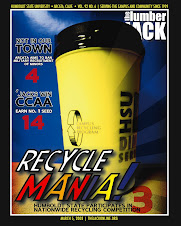
Apr 29, 2009

Boys will be Girls


Sometimes trouble hits you when you aren't looking.

That's what happened last week when the Lumberjack ran an ad on page four in the April 15 issue from someone purporting to seek people who could prove that anyone had been killed in a gas chamber at Auschwitz. In other words, it was run by someone who denies the Holocaust happened and who hopes to convince others.

Holocaust denier Bradley Smith has had a long history of trying to spread his message through college papers. These ads have appeared in the Lumberjack at least twice before, but not in recent years.

While HSU has given students the right to control the editorial content of the paper, until now it has not given them you the right to control advertising content. That power rested with the business manager and the journalism department.

But in 2006, the state legislature passed AB 2581
which prohibits any public college in California from censoring student newspapers. The Student Press Law Center believes this includes advertisements. So now students can decide whether or not a controversial ad will run.

With this power comes responsibility. You found this out last week, when the rabbi of Temple Beth El in Eureka asked members of her congregation to write letters to the Lumberjack protesting the publishing of the ad. Some 2o letters are running in the April 29 issue. Had you reacted with inconsideration you would face the prospect of a protest rally outside your windows and possibly a boycott by your other advertisers.

You chose instead to welcome the letters, run an apology to readers for your failure to adequately label the advertisement as a paid ad, and you decided to turn down Mr. Smith's request to run the ad again.

These are tough decisions to make.


But let's get back to the
April 22 issue.

You had some nice features in this issue, particularly the Oliver profile, the Art Gone Wild, the ice cream story and the tennis club profile. But except for the 420 photos, the ice cream photos, the wild art shots, the art was dull and the pages gray. The art photos could have been bigger. And don't use stock photos for sports unless the story is a profile.


You started many of the stories with strong ledes:

Between the lipsynced performances, glittering outfits and the occasional penis peek-a-boo, the Night of Drag Show had the audience laughing so loud it took a few minutes for the room to stop echoing.

We all have our secrets, but some secrets should not carry the burden of fear.

Bounce. Smack. Bounce. Smack. The sounds echo across the courts as you prepare your next move. Snap. The ball hits the net, and a point is lost. A loud groan leaves your opponent's gritted teeth. You have won.

It took three bullets to instantly change Travon Oliver's life forever.

But see in the last two examples how you can make your writing more powerful.

Three bullets changed Travon Oliver's life.

A loud groan leaves your opponent's gritted teeth. You won.
And a litt
le tightening improves the SLAMfest lede too:

You are driving down by the Arcata Bottoms and you see an omnipresent glow on top of the hill. You wonder what that glow could be, and for a brief moment it reminds you of a scene from E.T.
You drive down by the Arcata Bottoms and you see a glow on top of the hill like a scene from E.T.


After you nail the lede, you need to slow down.


You rushed through the Drag Show story. You mention Sir Mix-A-Lot, but the little old lady from Fortuna doesn't know who that is.

And then you tell us about Ana Kolpin who gets spanked for money, but you don't
explain how she raises $150 in donations. The story was confusing: Was this a story about a Drag Show for the Day of Silence or a story about a student trying to raise money for the AIDS ride?

The SLAMfest story was also a mess.

You talk about Relight Redwood Bowl but you don't ever explain what that is.

Much clearer was the story on t
he Day of Silence.

The interview via notes was very effective. You might have had Maria Melnik rip out one of those sheets and scanned them in for a graphic.

Don't misuse commas!

See the comma guide on the side of this page.

It showed potential students and their parents, that all students are accepted and respected for who they are at HSU.

You needed a comma after students or you needed to take out both the comma and the word their.
It showed potential students, and their parents, that all students are accepted...
It showed potential students and parents that all students are accepted.
Meanwhile, the misused comma was only one problem in this mangled sentenced.

Those who have seen protests from the Civil Rights era to the war in Vietnam, understand that one recurring theme is if there is any way to reach people, it is by getting them to think.


AP Style doesn't say to capitalize civil rights anything. And where are those people who saw protests? Not the writer of the story and not the people he interviewed for it. And the sentence makes no sense.


So ask yourself:


What am I trying to say?

Then say
it.


Don't bury your ledes

In the story on Summer L.E.A.P. I found the lede at the top of the second column.

Derek Hancey can't seem to get out of the water.
AA stands for Avoid Acronyms.

Instead of referring to Summer L.E.A.P. with the acronym, after the first reference just say the leadership program or the adventure program. Visually, acronyms disrupt copy flow.

The same went for the No means No story. Instead of NCRCT Client Services Coordinator, just say Mary
ann Hayes-Mariani, client services coordinator for the rape crisis team,...


Hyperbole is horrendous!

Merriam-Webster defines hyperbole as extravagant exaggeration.

So be careful how you describe things:

Student-led activities, like the protest held by the network and members of the Queer Student Union, demonstrate the epitome of student activism in human rights...


I would say that standing in front of a tank in Tiananmen Square
is the epitome of student activism. Keeping silent in the HSU Quad doesn't come close.

Delete d
ubious information.

You begin a paragraph in the Take Back the Night story this way:

Take Back the Night at HSU has a somewhat unknown timeline.

If I were editor, I'd have killed that whole section. Meanwhile, you needed to break out story about Cheri H
onkala.


Be curious. Ask questions.

In the Pell Grant story:

How many HSU students get Pell Grants?
How does one qualify? What are the criteria?


In the ice cream story:
What was in the shop before?
How much did they have to invest to open up the place?
Don't write backwards.

That's what you did with the film festival story. The kicker was your lede:

If you don't catch the 30 international films that will be screened at the 42nd Humboldt Film Festival this week, chances are that you won't ever see them.

Avoid the play by play

That's what you did with the baseball story. Instead, focus on the three best plays, slow down the action and take your readers onto the field.

Instead, I found the story near the end of the jump. The Jacks now sit 6-5 in the national Club Baseball League. They hope to pull off another sweep next weekend against Santa Cruz. That would put them in second place in the league and could get them a spot in the playoffs.

The rugby story showed how it is done, only try not to mix your metaphors

The Middlebury forward pitched the ball and the Jack's defenders proceeded to tackle him. He lowered his steel-like shoulder and bounced off player after player like a ping-pong ball.

Is he made of steel or is he a ping pong ball?




Apr 14, 2009

Some things aren't that easy


Don't promise what you can't deliver

The cover looked great but the story disappointed. Never promise
or tease the reader with something that you can't deliver. The cover promised a story about a problematic switchover from WebReg to Student Center, but you only had some mild complaints in the story.

The problem was that you missed the story. You bury and b
rush over this:
  1. That the software cost HSU $14 million
  2. That the reason the school had to buy it was that the chancellor forced it on all CSU's
  3. That it is made by a company called PeopleSoft.
What you didn't mention is that there are 23 campuses in the CSU system and HSU is one of the smaller ones. That means that PeopleSoft/Oracle is pulling in more than $300 million on this software transition. For that price it should be problem free software.

This could have been a great story. Next time you need to...


Do your research

If you had done a basic news background search on LexisNexis or Factiva, you would have found story after story about problems at other CSU campuses.

If you don't know how to do basic research you need to sit down with a reference librarian at the library. They will show you the great databases the library offers (which you can access from any
computer) and how to use them. Once you graduate, databases like LexisNexis and Factiva cost so much money, few newspapers give their reporters access to them.

I still found errors in this issue:

Staff Wrier
23 CSU's
People Soft
Who instead of which
Her instead of her
kids used as a reference to children
This years focus

Don't confuse your reader

I drew question marks in the margins of several stories. And that was the real problem with this issue.

Take for example the lede to the light bulb story:

LED lights are light everyday household items like digital clocks, remote controls and even the red stop light you almost ran through today.

I had to read that sentence three times and I still didn't get it.

In the same story you started one paragraph this way:

President of C. Crane Co. Rob C. Crane, discussed the creation fo the GeoBulb...

But you never told me about any C.Crane Co. so I didn't know who the heck this guy Rob C. Crane was or why he was in the story.

Then there was the profile of Julie Sheppard. She is separated from her twin for only one month of her life. But she's f
rom Los Angeles, and her twin just graduated from HSU and convinced her to enroll. So did she just hang out with her sister while the twin went to college? Or did the twin get a four year degree in one month? I couldn't figure it out.

In the P
lan-It Green story you mention Winzler and Kelly and the reader doesn't know who those two guys are or that it is the name of a local company.

And in the Men's Rugby story you have this sentence:

With Pleasant being a big factor in the 15 on 15 goal line stand, he is humble and looks forward to nationals.

What's a 15 on 15 goal line stand?


So SLOW DOWN

Take your reader slowly through the elements in the story. After each sentence ask yourself two questions:

Does the reader need to know this?
Will my reader be confused by this?


Meanwhile I still found way too much passive phrasing in your stories.

Not:
Making sure that its clients are well-fed is a main priority.
Instead:

The Endeavor's main priority is to keep its clients fed.
Not:

A number of the photographs were taken by A.W. Ericson...

Instead:

A.W. Ericson took a number of the photographs.


Keep it short

Your editorials are too wordy. You use an awful lot of words and space for a simple message: The school spent too much money for a new software program.

There was some nice showing in this issue.

Scott shook left, opening a little space for himself, then picked up speed and lowered his shoulder into a Western Oregon defender. The crowd was silenced as he moved his legs like a locomotive.
You asked some good questions in this issue but you need to...

Question the Answers

When you asked Slattery if she liked her experience at Humboldt she said: "Kind of, but not really."

But then you move on to a new question altogether, leaving the reader to wonder what about Humboldt Slattery doesn't like.


.


Apr 10, 2009

HSU Women's Rowing

You are Carless!! I mean Careless!! Some horrendous mistakes appeared throughout the issue including on the cover and in the headlines. You are careless on grammar, on spelling and on AP Style. You need to get nit picky about your copy. You will be judged by it, and it will not disappear off the Web.

Here are just some of the mistakes:

Womens Rowing
last years non natives
10:00 a.m.
she expects this years to be...
Dr. Dorsi (who is not a medical doctor so it violates AP Style)
Furnature
1.8 billion dollars
sentaments


Use Active Verbs
You still need to work on making your passive sentences active. See: Passive:
Raja Storr sits at a picnic table stringing necklaces of beads and shells preparing gifts to honor tribal dancers at this year's California Big Time celebration.
Active:
Raja Storr sits at a picnic table. She strings necklaces of beads and shells to honor tribal dancers at this year's California Big Time celebration.
Your put more creativity into your ledes in this issue. I spotted some good tries and a few very good examples.

The good examples:

Living in a wet and gloomy environment is a downer. It doesn't help when people are colder than the weather.
Paint is retouched, light fixtures are fastened, tables and chairs are put in place and everyone is running around in complete panic.

On a misty Wednesday afternoon, Redwood Bowl is abuzz with the pop of helmet on helmet tackling drills. (although if you take out the "tackling drills" the lede ends with a bigger bang.)
You had some good photos, particularly in sports.

But overall, the paper still lacks creativity and attitude. The design is clean, not captivating.

And while the stories are interesting, they lack real relevance in a time of hardship and anxiety.

Look for stories that will help your readers survive these difficult times, and take action.

I liked the profiles, but they needed a connecting overview that explained why you are doing them and what these people represent. Also I was disappointed that you did not try for some kind of diversity -- there are students of many different ethnicities here at Humboldt, but I didn't see that reflected in your choices for the profiles. You need to be proactive in making your copy reflective of the diverse student body we have.

And though I think humor is important, it tends to not work in the editorial. Save your editorial for focused, serious discussions.


Email me!

at mib3@humboldt.edu

Marcy's Top Ten Rules

1. Use active verbs.
2. Don't be afraid to paraphrase.
3. Question the answers to the questions you ask.
4. Substance always adds to style.
5. Honesty overrides all other journalistic rules.
6. Accuracy is not the same as truth.
7. Getting two sides to a story is not the same as balance.
8. Show don't tell.
9. Write with all five senses.
10. Give voice to the voiceless.

Movies about newspaper reporters

  • Futureworld
  • Salvador
  • The Return of Doctor X
  • Missing
  • All the Presidents Men
  • Scoop
  • The Quiet American
  • Foreign Correspondent
  • Gentleman's Agreement
  • Under Fire
  • The Parallax View
  • The Mean Season
  • Defense of the Realm
  • Superman 1-7
  • The Front Page
  • His Girl Friday
  • The Year of Living Dangerously
  • The Killing Fields
  • Inherit the Wind
  • True Crime
  • The Paper
  • Deadline-USA
  • Call Northside 777