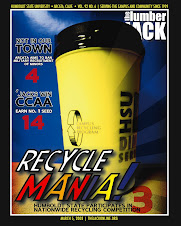
This was another good issue. The cover looked great and gave the story about the university center plans the prominence it deserved.
Students in the workshop liked:
- The terrific job the sports editor producing the copy for her section single-handedly.
- The flow chart to the university story was terrific.
- The photo on the fencing story.
- The bongs and bongos story
- The tilting of the photos on page 21.
- The monkey graphic on page 6.
They thought the following things could be improved:- The lack of photos
- Use of unidentified people or incorrect identifications of people
- No story about the Take Back the Night rally
- Coverage of Tegan and Sarah but not for Death Cab for Cutie
- The online poll was ridiculous
There was some solid reporting
Good information and good sourcing on the university center story, the monkey research, the knotweed problem and the grant for the Arcata Endeavor. The stories on the Marching Lumberjacks and Tegan and Sara were good reads.
And the story about the photo exhibit was a great example of showing not telling. But..
Work on your headlines
- When you tell the reader in the head that University Center plans are unclear, you tell them that there is little reason to read the story. If it is unclear to you than what could you tell them? Never give readers reasons to skip the story.
- You needed to flip the head and subhead on the knotweed story. The idea of foreign weeds threatening local ecosystems seems a whole lot more relevant that public land agencies battling a Japanese weed.
- Who is going to read a story with this headline?: Details emerge about program prioritization
So ask yourself: What is the story about?
- Is it about implementation of the provost's program prioritization task force as the lede says? No. It is about the threat that academic programs will be cut. Or in even more relevant terms, it is about students losing courses they need or care about.
- Is the university center story about Rollin Richmond addressing the UC Board of Directors, which is how the lede begins? No. It is about the university trying to bring in retail businesses that could generate cash, but that the plans could take power away from students.
Don't repeat
The weed story begins with a weed warrior waiting to spot unwanted plants. Then the next graph we meet Jennifer Wheller who is trying to rid the land of weeks. Then in the third graph we find out that she works for the BLM which is waging war on weeds.
Flip passive sentences to make them active
In the program priortization story we see this sentence:
It was to answer these questions and rank the academic programs that the task force was created.
If you flip it you get:
The dean formed the task force to answer these questions and rank the academic programs.
Instead of:
The Endeavor has been granted $50,000 by the Sisters of St. Joseph of Orange...
If you flip it you get:
The Sisters of St. Joseph of Orange gave the Endeavor $50,000 to...
Kill undescriptive adjectives such as "very"
Don't use words like "famous" or "ironic" that should be self-evident: If someone is really famous you don't have to tell the reader he is famous. If something is ironic you don't need to tell the reader.
Don't contradict yourself
The editorial was confusing. You start by saying that it has been two years since a sexual assault happen at HSU. But then you talk about a sexual assault that happened in March. Slow down and explain yourself clearly, one fact at a time.
Once again Forum looked great.
This was another good issue. The cover was creative and informative.
Vicky Sama's Beginning Reporting class took a go at critiquing and had a number of constructive things to say:
- They spotted a number of terrible headlines
- They wanted more stories about club sports
- Too many stories jumped; they said trim the stories to eliminate the jumps or better manage the layout to avoid them.
- They wanted more subheads for headlines and more info boxes.
- They suggested a sports calendar to brief results of away games and to preview upcoming stories.
Students in the Lumberjack class had both good and bad things to say: - They loved the cover
- The editorial was strong
- The candidate forums were a good idea
- The entire Forum section was a good read
- The softball pictures were good
On the other hand: - The wrong story on page 24 seems to jump to page 25.
- The whale photos were laid out in a different section than the whale story.
- You needed a better headline on the Take back the night story.
- The bus story listed the wrong time boarding time for the bus.
- You printed the poll results but left out the poll question.
Steer your reader to important stories
While the issue looked terrific, the layout doesn't indicate which stories are more or less important. First off, there seem to be four cover stories. In terms of content, the students tr aveling to Sacramento is the most important but you lay it out on page 4. Instead, the most important story should on the first news page, which is page 3. Also note that the reader's eye goes to the right first, which means that stories on odd pages appear on first glance to be more prominent.
Watch out when you use statistics
In the story about assaults you cite a statistic that one out of every four women will be raped some time in their lives. When someone gives you a statistic find out the original source of the data. That one in four statistic is widely cited and widely reported but dates back to a 1992 study. Whether it is still accurate is questionable. Meanwhile you buried the much more recent and relevant statistics -- that in 2006 and 2007 there were at least two rapes and nine sexual assaults on this campus. Finally in that sexual assault story, you failed to report and discuss the latest report -- an alleged sexual assault in the dorms in the last two weeks.
Clarity is King
The Restructuring story was confusing. When you don't have all the facts you need to let your reader know exactly what you know and what you don't.
Use active verbs
Not: Are planning to
Instead: Plan to
Not: Is graduating Instead: Graduates this May Not: Will be taking place Instead: Will occur
Break up quotes
Instead of: Amy Moore of Associated Students said, "Students and administrators have never marched together before. We are going to show the state that the education system is united."
Instead try paraphrasing the beginning: Associated Students representative Amy Moore said that this is the first time that students and administrators will march together. "We are going to show the state that the education system is united," she said.
Know when to use the WHEN
For your lede, the WHAT is almost always more important than the WHEN or the WHO. That goes double when the what is confrontation with a big who -- Arnold Schwarzenegger. You began the bus story with 2.a.m. and you start the editorial with Wednesday, April 9. Use the WHEN only when it is imminent.
Use strong verbs
Instead of:
There they will make their voices heard by the state..
How about:
...they will confront Governor Arnold Schwarzenegger...
This was a beautiful cover and a nice looking issue.
You included some excellent stories in this issue:
- Terrific sourcing on the Arcata Endeavor story. You went beyond quoting John Shelter as the rest of the press tends to do. You went from the Endeavor to Machi and then questioned the answers Machi gave you by going to St. Albans. Nice job.
- Nice story on Big Time. It focused in advance on a story that shows what makes Humboldt State unique, it focuses on students, who are your core readership, and it focuses on a topic important to an often marginalized community. Plus it was a good read.
- Well-organized, informative story on Jason Robo.
But you missed some important stories.
A Humboldt State student was arrested for sexual assault in the dorms, just one week before Take Back the Night. Not only did you miss the arrest, you missed previewing Take Back the Night, which means you missed the opportunity to readdress past assaults on campus that the police have done little about.
Don't slp on speling
The copy is much cleaner in terms of grammar than it was at the start of the term (yay!) but now you are starting to slip on spelling: - Decend on the cover was a pity
- Gust columnnist for Tom Jones was hysterical
 Show, don't tell.
Circuses are visual so show us a circus. To cover something as a preview, get the artists in the story to demonstrate for you what they will perform. You need to show readers what they can expect to see.
The same went for the story on the athletic teams raising money for Make-A-Wish. How do you show readers a "fun-filled event"? By showing them women basketball players in wigs. What did those wigs looked like. What kinds of wigs? Show me men in basketball shorts and suit shirts and ties.
Show me the Marching Lumberjacks in free-spirited attire. What does that mean? I can't see free-spirited attire.
Show me the third-inning threat and the diving catch over the fence in left field that shut it down.
Show me two people poking each other with dangerously pointy sticks in a sport they call fencing.
Kill the term when asked...
- ...when asked how difficult it was to referee for players he knew, Cox said...
- ...when asked about the weekend as a whole, senior pitcher Lizzy Prescott said...
- ...when asked about the games next weekend, Manata said...
Don't presume the reader knows 
You start off the German elimination story (great headline!!) with THE degree elimination but the reader doesn't know what you are talking about.
Then you start the next paragraph with the current state is THE recommendation from THE Provost Council to discontinuethe German major.
Don't bury your ledes.
On UC Santa Cruz slugs 'Jacks:
- I found the lede in the fourth paragraph:
If a pitcher doesn't keep his fastballs down and lets breaking balls hang in the zone, it makes hitting a lot easier for the other team. That's what the 'Jacks discovered last weekend.
On the Make-A-Wish story- The lede was either the women wearing wigs in the 10th paragraph or how difficult it is for former running back Marcus Cox to blow the whistle on players he knows in the 14th graph.
Move your stories forward
With sports, ask about and emphasize the future stories over the stories the reader missed. Okay so the Slugs crushed the 'Jacks. What's Stanford like? Who won/lost the last time the two teams played? What's UC San Diego like? What can the reader expect to see?
What is it about noun-pronoun agreement that you can't seem to get? A fencing club is an it, not a they.
Bring your stories to life!
 Some of the stories read as if you yawned while reporting and writing them. Figure out what is interesting about fencing. Don't just cover an event to cover it.
What's unusual, strange, wierd? What makes it special? All stories are about people. If you find the activity dull, find out more about the people involved. They are likely interesting people. It is your job to bring a story to life.
Finally, once again Forum rocked!
In the class, students said they liked the graphics in this issue, as well as the cover. One thought that the packaging of the stories gave the issue a feeling of importance and focus. They liked the layout of the forum section and the use of color.
On the other hand, they thought it a shame that the photo spread was in black and white (an error of the printer). Some ledes were too long. One student didn't understand from the story on Scotch Broom, why the plant is so pesky. Another student felt there was too much white space in the design of the ballet story. And a student was disappointed with the story about CASA.
Here is my take
It is nice to see a special issue and children make a great topic for a special issue. But the cover story seems to be the CASA story so it should be on page three rather than page 24. I guess it ended up in the back of the paper because it was assigned as a Culture story, but you need to get be more flexible with the layout of the paper.
Get organized!
I found the CASA story confusing. First you introduce Shannon Balke, but then you go to Genniene Dison. It seems as if they must be connected. But they aren't. Then you bounce to Steve Volow, then back to Balke then back to Dison. So here's what you need to do next time:
- Outline the story. It would work better if you start with Balke, give the reader a strong nut graph that summarizes all the key points in the story, then return to Balke. You don't want to leave Balke until you are all but done with her story. Then go to Dison, then Steve Volow. Each perso
 n you go to should represent a different key element of the story. That way readers understand why they are being introduced to different people. Without that, readers don't understand why the story goes on and on.
- Imagine the reader is a guest at your party and doesn't know anyone. So you say: I'd like to introduce you to Shannon Belke, because she used to be in foster care and is now with CASA. And here, have you met Genniene Dison? She's with CASA and you need to meet her because she helps kids with special needs. And here's Erika Benson. She's important because she started working with CASA while in college and can tell you how difficult it is to be a volunteer....
Ask: Why?
You cover the story about self-defense for children as an event without adequately explaining why the event is important. The lede says that parents instinctively want to protect their children. But you don't present the reader with any parents who worry about abductions. This is a case of telling, not showing. Show me a fearful parent. And show me why it is important to teach children as young as nine self-defense against kidnappers. How might you do that? By recapping some recent news stories about child abductions combined with federal, state or local data. You could have run a Megan's List check to see how many child molesters are in Humboldt County (a lot!) Without that, this story was simply an event preview.
 Don't forget your -ologist!
You needed to add substance to the playground story as well by establishing how badly playgrounds are needed in Eureka and Humboldt County.
How many are there per capita and how does that compare to other places around the state? You could find some sociologist to tell you how important it is to the health of a neighborhood to have safe outdoor places for children to play.
Pronouns can be so disagreeable!
- A group is an it, not a they.
- The Child Development Laboratory is an it not a they.
- The ballet is an it, not a they.
Describe the action
Sports stories are about action so you need to describe the action. When you cover a game or a competition, imagine that you stand next to a blind person who doesn't know what is happening. Every time the crowd cheers he elbows you and says, what happened? Describe what happened for him.
Don't use unnamed sources
Instead of an unnamed spokesperson from county health and human services find someone named who can tell you the same thing. Or get the unnamed person to point you to the legislation or rules so that you can cite that.
Instead of an unnamed person who adopted Lester, find a named person who adopted a fish. That way, you could have that person as your lead, following Lester the fish from the origination point to the spawning ground.
Why do those ledes like to hide?
I found the lede for the Albino! story in the beginning of the jump page:When the afrobeat band Albino! performs, the drums communicate with the congos and bass. "We all listen to each oterh in a very deep way, almost as in speech," said Michael Bello, who plays keyboards and saxophone and sings lead vocals. "In this spirit we support each other."
And the lede for the Scotch Broom story was in the 10th paragraph:
The bush Scotch Broom is so invasive that each plant produces thousands of long-lasting seeds. You can pull it out. But the plant you pull likely sowed its seeds already; those seeds that will create plants some do-gooder will need to pull decades from now.
Hopefully that won't deter an army of Broom pullers that state and national park rangers need to restore grassy areas in the Bald Hills.
 Enough of the griping:
- The layout of forum rocked!
- Loved the illustration on the track story.
- The farmer's market story wove together nice sources with great data and history.
- Loved the story about how no one showed up for the track meet but they still held it. That's the Lumberjack spirit.
- Great coverage online of the fire at the woman's shelter.
Email me!
at mib3@humboldt.edu
Marcy's Top Ten Rules
1. Use active verbs.
2. Don't be afraid to paraphrase.
3. Question the answers to the questions you ask.
4. Substance always adds to style.
5. Honesty overrides all other journalistic rules.
6. Accuracy is not the same as truth.
7. Getting two sides to a story is not the same as balance.
8. Show don't tell.
9. Write with all five senses.
10. Give voice to the voiceless.
Movies about newspaper reporters
- Futureworld
- Salvador
- The Return of Doctor X
- Missing
- All the Presidents Men
- Scoop
- The Quiet American
- Foreign Correspondent
- Gentleman's Agreement
- Under Fire
- The Parallax View
- The Mean Season
- Defense of the Realm
- Superman 1-7
- The Front Page
- His Girl Friday
- The Year of Living Dangerously
- The Killing Fields
- Inherit the Wind
- True Crime
- The Paper
- Deadline-USA
- Call Northside 777